Showing posts with label Ngatimoti. Show all posts

Thursday, November 12, 2020

"Rathgar House": Ngatimoti's school hall and the McGaveston connection.


John Cornwall McGaveston
Born at Rathgar, Co. Dublin, Ireland,  1 January 1844
Died at Ngatimoti, Tasman, New Zealand, 13 May 192
5


On 20 September 1850 the ship "Mariner" arrived in Nelson, having sailed to New Zealand from London on 4 April 1850 with 172 passengers on board. Among them was Irish widow Margaret McGaveston nee Page with her two young sons, John Cornwall, aged 7, and 5 year old Charles Wynn. It was not the first sea voyage for the two little boys, who had accompanied their mother in 1848 when she sailed to India to sort out her late husband John Wynn McGaveston's affairs there - he had been a medical officer with the Hon. East India Company serving with the 2nd Bengal Artillery in India, but had died at Rathgar in 1846, not long after his retirement. Having qualified as a surgeon in Ireland in 1823 he had joined the army at Rangoon by the time war with Burma broke out in 1824. 

Margaret McGaveston had travelled on the "Mariner" under the protection of  the Rev. Robert John Lloyd from New Ross, Co. Wexford. Although posing as a married couple, they did not in fact get married  until soon after their arrival in Nelson - their  marriage taking place in Wakefield at the Wakefield Church on 19 November 1850. Both her own family and her McGaveston in-laws had had their doubts about the Rev. Lloyd, but Margaret McGaveston could not be dissuaded from the relationship and cut off any communication with them. Unfortunately, they were right to be concerned. It soon became clear that the Rev. Lloyd had found Margaret's inheritance from her first husband to be her most attractive feature and it appears that her life with him became an increasingly unhappy one. 

The couple started farming in Riwaka, and John and his brother Charles soon acquired a half-brother, Bartholomew, born at Riwaka on 19 June 1851. Known as Barty,  he inherited "Sandy Cove" after his father's death in 1875, and was the oldest of the 3 surviving children born to the Rev. Lloyd and the former Margaret McGaveston. In January 1877 John McGaveston would go to the Motueka wharf with Barty to greet another Irish family who  had just arrived - William & Ann Brereton, their children, and Mrs Brereton's sisters Letitia and Lizzie Bridge. They were taken to Barty Lloyd's Pangatotara home,  where they were very nearly drowned during the ferocious storm which hit the Motueka Valley between the 6th and 7th of February, 1877,  resulting in a benchmark inundation which became known locally as the "Old Man Flood".
 
Another of Ann Brereton's sisters, Matilda (Tilly) Whelan nee Bridge, later came out from Ireland with her children to join them at Ngatimoti after being widowed in 1889. The Rev. Robert Lloyd was Mrs Brereton's maternal uncle, and in 1880 his son Barty Lloyd married his cousin Letitia Bridge. Cyprian Brereton would later write about the Breretons, Lloyds, Whelans and McGavestons in his book "No Roll of Drums", the stories of Ngatimoti's pioneers.

John's younger brother Charles was killed in 1855 after being gored by a bull, and his mother died at Riwaka in 1859, leaving John the only remaining member of the small family which had emigrated to New Zealand. He had been witness to this mother's mistreatment and did not get on with either his step-father or half-brother, Barty, so this was a lonely and difficult time for him, An unconfirmed family story has it that after his mother's death he was so unhappy that he ran away to sea for a time. 

It's likely that the turning point for John McGaveston came when he met Ngatimoti settler John Park Salisbury, who around the same time that John was building a house at Pangatotara was also building a home in the same area for his wife, Clara nee Deck. Clara was a daughter of Plymouth Brethren evangelist James George Deck, who had settled on a farm in the Waiwhero Valley between Lower Moutere and Ngatimoti (still in existence and now known as The Lodge at Paratiho Farms)  James Deck had soon became an influential force in the area and converted a number of settlers to the Brethren cause, including John Salisbury. It's very likely that it was through a connection with John Salisbury that John McGaveston also joined the Plymouth Brethren, a move which brought new purpose to his life.

Over the years John  married twice and with 18 children to his credit, became patriarch of his own McGaveston clan. John was married firstly by the Registrar at Motueka on 23 December, 1862 to Mary Ann White, daughter of Riwaka settlers David White and his wife Sarah (nee Jenkins), originally from Alton, Hampshire, in England. He may well have met Mary Ann through her brothers, George and David White Jnr, with whom he is known to have served in the No 5 Company of the Motueka Militia in 1860,  Mary Ann's older sister, Elizabeth White, had married  in 1862  to  sawyer Joseph Dale Knowles, whose Pangatotara property (still owned by his descendants today) adjoined "Sandy Cove". Mary Ann had 9 children but on 8 September 1876 she died giving birth to a 10th baby, which didn't survive. She was buried at the nearby Pangatotara Cemetery, which was washed away the following year by the "Old Man Flood".  

On 3 October 1877 John was married secondly at Wakefield to Penelope Dean Wallis, whom he possibly met through his connection to the Daniell brothers  who at the time appear to have also been members of the Plymouth Brethren. Penelope was singularly well qualified to take on a large family of step-children, added to over time by her own brood of eight. As a daughter of Richard Wallis and Mary Ann Lake Wallis, who ran orphanages at both "The Gables" on Thorp Street in Motueka and then at "Hulmers" on Chamberlain Street, Lower Moutere, Penelope had grown up looking after many younger children. 


"Wallingford House", Rathgar, Co Dublin",John Cornwall McGaveston's birthplace
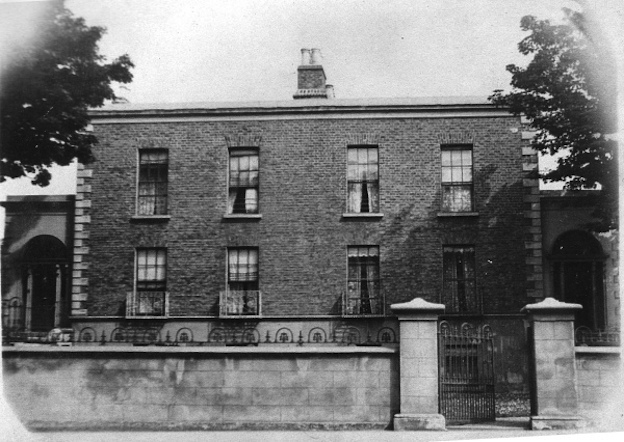

                                     "Wallingford House", Rathgar, Co. Dublin, Ireland.


John Cornwall McGaveston was born in Ireland at "Wallingford House, Rathgar, County Dublin, Ireland, on 1 January 1844, being the first child of Dr John Wynn McGaveston and his wife Margaret nee Page. Dr McGaveston was a surgeon in the service of the Honourable East India Company's military branch, attached to various regiments in India, Afghanistan and Burma (now Myanmar), but he retired a year after his marriage in 1842 and returned to live permanently at his home in Ireland. Although established in Ireland by the 18th century, the McGaveston surname is thought to have its roots in Gascony, and is linked by family legend to Piers de Gaveston, an English nobleman of Gascon origin who came to a sticky end at the hands of jealous rivals after becoming a favourite of King Edward II of England. Gaveston did spend time between 1308-1309 in Ireland after being appointed the King's Lieutenant in that country and was rumoured to have had an illegitimate son from whom the present McGaveston line was descended. Although this connection seems likely, it has not as yet been definitively proven. John's second name was a nod to Gaveston's title, the 1st Duke of Cornwall, and "Piers" is another name which often appeared in the McGaveston line.

 Before his marriage, Dr McGaveston was already living at "Wallingford House", a rented home situated on Rathgar Road in Rathgar, then a small village on the outskirts of Dublin, but now a suburb of Dublin City.  He shared it with his brother Nicholas McGaveston and Nicholas' wife Catherine, a good arrangement as until 1842 he was often away in India.  After their wedding in 1842, Dr McGaveston's bride Margaret joined the household, and this is where their two sons were born. Dr John Wynn McGaveston retired from service with the Indian Army at the time of his marriage and died at his Rathgar home in 1846.


"Rathgar" No 1, Pokororo, West Bank, Motueka Valley (later known as "Riversdale")


                                Copy of a photograph of the McGaveston home block taken by 
                             John Edward Salisbury, son of John Salisbury and Clara nee Deck,
                                  neighbour and good friend of the McGaveston family, showing
                                                             his trademark intials,  J.E.S.
                                          

After his marriage to his first wife, Mary Ann nee White, John McGaveston moved with her and their first child, Henry, to Pangatotara where he had  built a house on a section from the "Sandy Cove" block, first leased, then bought from his step-father,  however he had moved away well before the catastrophic "Old Man Flood" in February 1877 which devastated many Pangatotara farms. When he came of age in 1865, John inherited a substantial sum of money, including his deceased brother's portion, which had been willed to his two sons by their father. This came from investments made by Dr McGaveston in Bengal Government Securities in India, and had fortunately been held safely in trust for him by his uncle Nicholas McGaveston in Dublin. This windfall enabled John McGaveston to buy several sections around the Big Pokororo River on the west bank of the Motueka River. These formed the homestead block with which his family would be associated for many years. He developed a substantial mixed farm there carrying sheep and cattle as well as crops, and when pastoral leases on the Mount Arthur Tableland were made available in the 1870s, took up a run in the Cobb Valley. The Breretons were farming neighbours and recalled the McGavestons with their large blended family as being "wonderfully  hospitable". 


                                    McGaveston family group in front of their Pokororo home
                  Lt-rt: John McGaveston, Anne, Penelope and Ralph (both seated), Theo, 
                                                                  Dora and Arthur.
                                                       
                         
In memory, his father's Irish home was John McGaveston's happy place, a reminder of his early years growing up within a loving family circle long since lost, and so he named his Pokororo farm '"Rathgar" after the place where he was born. This property, along with its original homestead, was in more recent times owned by Yorkshireman Dave Gorrill, followed by his son Martin. John McGaveston had built this two-storeyed home on the river flats in 1878, but the threat posed by ongoing floods led him to successfully move the house up onto the terrace in 1891.This was a major mission, as the piles had to be removed and the building shifted in one piece, using logs beneath as rollers and a team of horses. The timing was good - in 1894 another flood washed right over the flats where the house had previously stood. Until the Peninsula Bridge was opened in 1913, getting across the Motueka River involved using a canoe or the aerial cage set up by John McGaveston which crossed almost opposite the site of the Whelan home on the east bank. When first built, this aerial cage gave access across the river to settlers on the West Bank of the Motueka River and diggers from the Tableland would use it to reach Alf Daniell's store on the opposite side of the river when they needed supplies. 
                                                                            
                              The McGavestons' aerial cage, used to cross the Motueka River.
                         Arthur McGaveston in front, with his father John McGaveston behind.
                         A dog sitting front left awaits them, having likely swum across the river.
                 Whelan home in the background is today sited at 1445 Motueka Valley Highway.


 John McGaveston had a close connection with the storekeeping Daniell brothers, and became related by marriage -  Alfred Daniell and his brother George both married sisters of McGaveston's second wife, Penelope Wallis. The Daniell brothers had early on become converts of charismatic Plymouth Brethren preacher James George Deck, then living at what is now the Paritiho Lodge Farm on Waiwhero Road between Lower Moutere and Ngatimoti, although both appear to have later ended up in the Anglican fold. John McGaveston, whose parents and step-father would have been members of the Church of Ireland, also joined the Plymouth Brethren, as did his family. He was very likely influenced to make this move by early Ngatimoti settler, John Park Salisbury, whom he may well have met while building his home at Pangatotara in 1862. John Salisbury, was also building a pit-sawn timber house which he called "Silverdale" at Pangatotara that same year, so to have a place suitable to bring his new bride, Clara, a daughter of James George Deck. Salisbury, who now became Deck's son-in-law, became a life-long and ardent evangelist for the Brethren cause, travelling widely around the country in his mission to bring more people into the Brethren fold. Ngatimoti's earliest European  residents tended to have been either members of the Plymouth Brethren or the Church of England, though religious preferences don't appear in those earlier times to have been a cause for conflict.

It's quite likely that when John Park Salisbury and his family decided in 1872 to move to a farm at Pokororo, that they chose to take up land near congenial acquaintances like the Breretons and McGavestons. John Park's son John Edward Salisbury became a particularly good friend and often visited the McGaveston home. A keen photographer, he took several photos of the McGaveston family and their home, but unfortunately very few have survived.


                         "Rathgar" No 2, Greenhill Road, East Bank, Ngatimoti.


                                  Four generations at "Rathgar House", Greenhill Road, Ngatimoti,
                                                                                  ca 1908-9 

                 Lt-rt: Seated, Penelope McGaveston (nee Wallis), centre back her son Dean McGaveston.
                          Penelope's mother Mary Ann Wallis is seated right, holding one of Dean's children,
                                                     possibly Trixie McGaveston, born in 1908.


As time passed John McGaveston decided to retire and let his sons take care of the farm. Around the turn of the twentieth century a large local run known as the Johansen Estate was broken up and lots in the Greenhill area were auctioned off in 1906. Cyprian Brereton's aunt Matilda Whelan and her son William bought two of these blocks between them and sold a 5-acre piece to John McGaveston for a retirement home. He had a large house built there, and by 1908 had moved in with his wife Penelope, his 3 youngest daughters - Dora, Anna & Evelyn - and son Ralph, who daily crossed the river with a horse-drawn cart to work the lower part of the Pokororo farm on the West Bank of the Motueka River. Other members of the family also settled nearby and for some years Greenhill Road was McGaveston Central. Son Dean Wallis McGaveston, a well-known local drover, had a block at Greenhill called "Toko Ma" (White Rock), and an unmarried  daughter from his first marriage, Amelia McGaveston (known as Millie), moved into a home on Greenhill Road right opposite the new McGaveston retirement homestead, where she raised her nephew Francis ((Frank) Piesse, the son of her sister Mary, who had died in 1912 after giving birth to him. John McGaveston's son Nicholas Arthur, who in 1909 married Ella Burrell, a daughter of early Orinoco settlers Edward Fearon and Emily (nee Bowden) Burrell, took over the old "Rathgar" homestead block at Pokororo. By mutual agreement, its name, "Rathgar", was transferred to the elder McGavestons' new home on Greenhill Road and Arthur renamed the Pokororo farm "Riversdale". 


                "Rathgar House", Ngatimoti School, Greenhill Road, Ngatimoti.


John McGaveston died in 1925 and his widow Penelope in 1932. They now lie next to each other at the old Waiwhero Cemetery next to the Paratiho Lodge Farm homestead block. Son Dean moved to Lower Moutere. Arthur died in 1937 and his oldest son, Keith, took over  the "Riversdale" farm in turn. John and Penelope McGaveston's daughters Dora and Anna stayed on with their brother Ralph at the Greenhill "Rathgar" home. Evelyn had married in 1927 and Anna made a late marriage in 1947. Neither Dora nor her brother Ralph ever married, and were the last McGaveston family members to live at the Greenhill "Rathgar". About 1950 they moved together to a home in Richmond and "Rathgar" was put on the market.

The Ngatimoti school (the second one built) was at that time on Waiwhero Road near the current Memorial Hall, on a site bought from the Daniell family, who had taken up land there and set up a new store after the Greenhill block was sold. The school had grown but couldn't expand because the site was too small. The easily accessible 5 acre "Rathgar" block, a relatively centrally located property at Greenhill, seemed like an ideal place to build a new school. The Nelson Education Board was at first reluctant but eventually persuaded that this was a good idea and around 1952  "Rathgar" was acquired for that purpose. The shift from the old school down the road took a while to complete, in fact the official opening did not take place till 1954. Some classes continued at the old school while others were held on the Greenhill site in the old "Rathgar" home, in a pre-fab building and also in a classroom block relocated from the other school until purpose-built schoolrooms were finished. 


The old house eventually had to go to make space for classrooms, and a demolition squad of volunteers got together to do the job. It occurred to one of the parents involved that some rooms could easily be saved and made into a school hall. Others agreed and they set to work to make the conversion. This means that, unusually, Ngatimoti's school hall belongs to the school community rather than the Ministry of Education. Over the years it has often served as an extra classroom, been used by the cricket club, for Friday night folk dances,  a weekly pre-schoolers' Playgroup, and hired out for events like birthday parties. A number of working bees  have been held by members of the community over the years to help maintain and improve the hall. In 2018 the school's Board of Trustees decided to give the hall a major overhaul. The whole building was earthquake strengthened, insulated, re-piled, and a new deck and verandah were built. The Student Council felt tthat their new-look hall deserved a name of its own, and  as a consequence when it was officially reopened in June 2019, it was formally dubbed "Rathgar House" in recognition of its connection with the McGaveston family.


Acknowledgements

For her extensive work, McGaveston family history researcher Mrs Ruth Pahl, grand-daughter of Nicholas Arthur McGaveston & his wife Ella nee Burrell.

Mr Edward Stevens, Ngatimoti historian, always happy and willing to share his valuable knowledge.


Sources

Brereton, Cyprian Bridge, No Roll of Drums. Pub 1947 by AH & AW Reed, Wellington.
An informal and engaging history of the settlement of Ngatimoti and its early European settlers.

 
Day, Cameron, writing as "Cerebuscoins", The McGaveston Family of Ireland: Family History Research. 

This extensive blog post contains a goldmine of information and includes many interesting photographs.


Daniell Brothers, Alfred & George, Storekeepers at Ngatimoti and Brightwater.
Rustlings in the Wind blog

Monday, October 13, 2014

GREEN, James Leslie (Les) 1891-1917

Second Lieutenant Les Green, WWI serial no 6/239
Canterbury Infantry 2nd Battalion,  
 Main Body, NZ Expeditionary Force.
   
You won’t find Charles Green’s name on any early pioneer ship passenger lists, though he travelled from England on the Bernicia, arriving in Nelson on November 5, 1848, from where he made his way to Motueka. He was one of the new colony's less orthodox settlers – the sailors who jumped ship when they reached New Zealand.

Founded in 1842, Motueka in 1848 was just starting to take on a settled appearance, being still very much a frontier town and covered to a large extent in bush - beech, totara, rimu and kahikatea, called “white pine” by the Pakeha settlers. Where High Street now runs was a rough and rutted track which made driving a bullock-drawn dray a rocky experience; capsizes were a common occurrence. Heavy work was done by bullock teams in the early days – horses came later.  Roads were rudimentary, with most travel being done by boat, either via the Motueka River or across the bay to Nelson. There was a large Māori community, to some degree itinerant. It's suggested that there could have been up to four pahs in different parts of Motueka, though there seems to be agreement that there was a well-established one at the corner of Pah and Grey Streets. [1] A number of settlers’ homes were scattered about, generally made of rammed earth or hand-sawn timber slabs. As more land was cleared, saw-pits were established to supply the growing demand for timber for building, and not surprisingly, Charles soon found work as a pit-sawyer.

Like any good story, the tale of 20-year-old Charles Green’s impetuous arrival in Motueka is a mix of fact and fable. Family legend has that the Bernicia visited the Motueka area and Charles seized the opportunity to make a run for it. Hotly pursued by other members of the crew, he escaped discovery by hiding at the Swan Hotel until his pursuers gave up the chase, aided and abetted by sympathetic hotelkeeper, Mrs Talbot.[2]

There is no record of the Bernicia calling in at Motueka, and it's much more likely that Charles would have legged it on arrival in Nelson and hitched a lift from there across Blind Bay (now known as Tasman Bay) on one of the small vessels doing a brisk trade with Motueka in timber and vegetables grown in Motueka's fertile soil. Loading took place on the beach at the mouth of the Riwaka River. Moreover, the only licensed tavern in Motueka at the time was the Wheat Sheaf, situated at what is now the corner of Inglis and High Streets, though several unlicensed premises were known to have existed as well. [3] Although later a favourite Green watering hole, the Swan Hotel was not in operation before 1854, nor were Daniel and Mary Talbot licensees there until 1862. Perhaps time and retelling have muddled the tale - the chase and the helpful barmaid may been in Nelson - or perhaps Charles enjoyed embroidering his youthful adventures for the entertainment of his children and grandchildren.

By whichever means Charles reached Motueka, jumping ship turned out to be a good call. The Bernicia and her crew came to a sticky end shortly after. Reports vary – one account has the ship taken and burnt by pirates, another says she was lost in the South Seas, and most of her hands killed and eaten by cannibals. [4] Charles was lucky – instead of sharing his shipmates’ fate he settled in a new land and did well for himself.

Charles Green was born on July 6, 1828, to John and Sarah (nee Gatton) Green, in Angmering, West Sussex, England, where his family can be traced back several generations to 1667. He first appeared officially in Motueka when he married Sarah Amelia Beresford on Christmas Eve, 1851, at the first St Thomas Anglican Church, built in 1848 on land in Thorp Street North donated by Motueka landowner, Captain Edward Fearon. Sarah was born in London in 1831 and emigrated to New Zealand on the ship Mary with her widowed father Samuel, a shoemaker, arriving in Nelson 24 February, 1849. By 1853 Samuel had settled in Motueka to be near his daughter, but died the following year in Nelson.

Charles Green Snr and his wife Sarah (nee Beresford), 1868.

Charles became a very successful farmer. He got a start in 1854 with 23 acres of Maori leasehold land in the Grey Street/Green Lane area of the Motueka township, Green Lane being named for him. In 1868 he started taking up land at Pokororo, on the east bank of the Motueka River, at that time still heavily wooded. His property eventually ran to 527 acres and included the hop gardens set up by his youngest son Joseph (Joe) in 1900 and now owned by the Thorn family. All this land had originally belonged to the Motueka Valley's earliest pioneers, brothers John Park, Tom and Edward Salisbury.  Over the years Charles added to his holdings 704 acres of sheep grazing land in the Mt Arthur/Pearse Valley area. By his death he held 1231 acres in total. He was also a member of the Independent Order of Oddfellows for more than forty years. In the days before the welfare state, Friendly Societies and Lodges provided support for members and their families in difficult times and served as an important networking tool for men of affairs in colonial New Zealand. Even a small town like Motueka had three different Lodges: the Oddfellows, the Freemasons and the Ancient Order of Foresters.

 Charles and Sarah made their home in Grey Street, Motueka, while Charles went out to Ngatimoti to work on the farm, where he had a whare for shelter. He was no doubt helped by his sons as they grew up. Charles Green worked closely with his farming neighbours, the Haycocks, and they shared many tasks like sowing oats and rye, harvesting crops, shearing sheep, clearing bush and cutting firewood. They also shared local vicissitudes like the great flood of 1877 - which destroyed Thomas Haycock's home and left the Greens' flats covered in logs, silt and sand - and the bushfires of 1888. There were at various stages three Haycocks faming at Pokororo - Thomas on the east bank of the Motueka River next to the Greens,' and on the west bank opposite, "Old James" (Thomas' brother), and "Young James", Thomas' son James Albon Haycock, a later mayor of Richmond, whose son Henry died of meningitis at Featherston Camp in 1917.

Charles and Sarah had 11 children, 8 boys and 3 girls, who attended the Motueka School. Sarah died of uterine cancer in 1880 at the age of 49, leaving 6 children still at home and her older daughters Sarah and Mary took over the household duties. Charles remarried in 1883 to Elizabeth Corrigan, formerly Seymour (nee McGee) at her residence in Collingwood Street, Nelson. Elizabeth had been married twice before and had 7 children. The newly married couple moved to Ngatimoti to live, with Charles’ younger sons Joseph and Henry and Elizabeth’s two youngest daughters attending Pokororo School. Charles served on the Pokororo School Committee in 1883-4. Charles and Elizabeth had no children together. They eventually retired to Motueka, leaving Charles’ sons to run the farms.[5] After Charles’ death, complications arising from his will continued for many years, with some aspects not being finally resolved until 1964.[6]

Charles Green Jnr, known as Charlie, (1857-1933) was born in Motueka and was Charles and Sarah’s third child. He would have grown up in town, but also working on his father’s farms as he grew older. On the 10th of May,1883, he married Jane (Jennie) Mickell of Riwaka at the home of her parents, James and Sarah (nee Goodall) Mickell, with Charlie's younger brother William as a witness. Jennie's grandfather, William Mickell, was an early Riwaka pioneer and ran Motueka’s first flourmill at Brooklyn. The original millstones he cut in 1844 were incorporated in the cairn raised in the 1930s to the memory of Captain Arthur Wakefield and the Riwaka settlers.[7] Charles Jnr and Jennie had 11 children: Rosabel, Dorothy, Beatrice (who died in her first year), Ernest (Ern), James (Les), Arthur, Winifred (Winnie), George, Marjory, Donald (who also died early), and Jane. Born at Pokororo on the 20th of July, 1891, James Leslie (known as Les), was their 5th child and second son. He inherited the distinctive strong facial features and dark colouring often seen in the Green family and attributed to his grandmother, Sarah, who was said to have had gyspy blood.

In 1881 Charles Jnr bought land i(Sections 2 & 3, Blk XI) at Pokororo in the Motueka Motueka Valley in partnership with his brother, William. This property was situated down the east bank of the Motueka River northwards from the Pokororo suspension bridge, built as a footbridge in 1894 and today the oldest bridge in the Tasman District still in use. Charlie Green granted access rights across his land for this bridge, which would have proven a boon for his children, who needed to cross the river to reach the Pokororo School on the west bank opposite. At the commencement of work on the bridge in February, 1894, the Colonist reported that Mrs Charles (Jennie) Green "drove the first pile admirably". The importance of bridges for early settlers was demonstrated by a turnout of 400 locals to celebrate the completion of this bridge with a public picnic on the riverbank. 

William Green and another of Charlie Green's younger brothers, David, fell out with their father, Charles Snr, over his second marriage and decamped to Taranaki where they worked together as rural contractors. David Green is thought to have operated the last bullock team in the Taranaki region. Neither William nor David was mentioned in their father’s will, so presumably they never reconciled. Charles Jnr bought out William’s share of their Pokororo farm, owning it outright by 1890. He also bought on his own account a 127 acre block at the end of today's Greenhill road on the east bank in 1906 when the Johansen Estate was subdivided (Lot 11 in the sale catalogue) and later a couple of blocks at Mount Arthur. He ran sheep on his own properties and from 1896 also leased land for grazing on the Tablelands, (also known as "Salisbury's Open"), first grazed by the Salisbury brothers.

Between 1913 and 1919 Charles Green drove the Royal Mail Coach from Pokororo on Mondays, Wednesdays and Fridays, collecting mail from Pokororo, Ngatimoti and Orinoco, and connecting with the Newmans' coach at Price’s Corner in the Moutere, for which he received one hundred and sixty pounds per annum.[8] On the way home he delivered mail to Ngatimoti and Orinoco residents, and little boys going home from school would try to jump onto the mounting step behind the coach and catch a ride. This could be a risky business, depending on Mr Green's mood. He was known on occasion to crack his long whip behind and gallop the horses to give the “passenger” at the rear a good fright. [9]  Ngatimoti oldtimer, Les Waghorn, remembered with amusement that "Charlie Green would never stop the horses, but as he came alongside of you his hand would shoot out and grab the mail as you held it out to him." [10] Around this time an area built on one end of the Greens’ front verandah served as the Pokororo Post Office, which was run by James’ sisters, Winnie, Marjory and Jane. The local telephone exchange was later added to the service, and to alert the girls in the house to calls, some 12 extension wires were strung around the family kitchen from bells in the office, each one representing a party line.

Two of James Green's sisters, thought to be Rosabel (Rosie) and Dorothy,
 at the family's Pokororo home.

The  house where James grew up was built on the east bank of the Motueka River, about 200m below the current access way to the Pokororo swing bridge. It no longer stands, having been demolished and replaced in more recent times by a home a little further up the access road.  Les Green and his siblings attended Pokororo School and in 1894 his father Charles was elected to the Pokororo School Committee. Although his grandfather married in an Anglican Church, James' family were Wesleyan Methodists. The Methodist missionaries were active in Motueka from the very start and the first Methodist chapel was erected in 1843. Charlie and Jennie Green always took the family on an annual summer holiday to Tapu Bay, travelling by horse and cart from Ngatimoti. They camped out in a large tent and Charlie would fish for snapper off the beach. When older, some of the children stayed at home to keep things running and like all teenagers, got up to the odd bit of mischief when left to their own devices and had to do a hasty scurry around to get things back in order before their parents returned!

Les would have been involved with farm work from an early age, and quite likely spent quite bit of time up on the Tablelands with a brother or two, taking care of the sheep pastured there and mustering them when it was time to move them on. [11] He is recorded  as working for his father and sheep-farming with his brother at Pokororo when he enlisted - this  was possibly his younger brother Arthur or his older brother, Ernest (Ern), who later ran sheep near the Granity Creek at the Pearse Valley and had a butchery business. No doubt the brothers would have also done some hunting for the pot while up on the Tablelands.

Tall and strongly built, Les was a talented athlete, who excelled in any sport he undertook. During his voyage on the troopship to Egypt in 1914 he won a boxing tournament and was awarded a golden medal, which later became one of his father's prized possessions. [12] Troops would be on board for five weeks or longer and sporting contests and boxing matches of this sort were commonly held to alleviate the tedium of routine drill, along with impromptu concerts in the evenings for entertainment. Les was particularly involved in cycle road racing. He was well-known in New Zealand road racing circles and must have spent many hours training on the local roads.

Although Les' grandfather Charles Snr was apparently horrified by this new-fangled invention,[13] from the 1890s the bicycle was adopted enthusiastically by young New Zealanders - it gave them freedom to get around independently in a way not previously available to them. Athletic and Cycling Clubs were soon formed around the country and both Nelson and Richmond had such clubs. Nelson’s club was a bit erratic and went into recession several times, but keen interest in cycle road racing in the Nelson area remained undiminished. Every year from 1899 the NZ Athletic and Cycle Union, in affiliation with the New Zealand League of Wheelmen, held a major Timaru to Christchurch road race. This race, which offered lucrative prizes, was sponsored by the Dunlop Pneumatic Tyre Company of Australasia. An annual Nelson to Belgrove race was part of the Dunlop competition circuit and hotly contested by riders from the Top of the South as it gave entry into the Timaru-Christchurch race and potential entry into the Australian competitive circuit. [14] Large crowds attended the start and finish of the Nelson to Belgrove races, with final laps often taking place at Trafalgar Park. [15] Les Green won the Nelson to Belgrove cycle road race before the start of the First World War, and also competed in other New Zealand races, including the Timaru-Christchurch race.

Starting line-up at the 1905 Timaru-Christchurch cycle road race.

A keen member of the 12th (Nelson and Marlborough) Territorials Regiment, Les was one of the earliest to join up from the Motueka area; he enlisted with the 12th (Nelson) Company, Canterbury Infantry Battalion, on the 15h of August, 1914, just four days after war with Germany was declared. He sailed on the troopship Athenic with the Main Body on October 16, 1914, along with several other men from Ngatimoti, including 12th Company commanding officer, Major C. B.Brereton, Hector Guy, William Ham, H.H. (Bert) Thomason, Ronald Slatter and Alan de Castro.

Les took part in the campaign on Gallipoli and was invalided from the Dardanelles to England, where he was admitted to the Canadian Red Cross Hospital, purpose-built at the Astor family estate, “Cliveden”, in Taplow, Buckinghamshire. He was initially reported as wounded but had in fact contracted bronchitis. On recovery he acted as an instructor at Sling Camp for about twelve months. Les’ qualities as a leader clearly shone through from very early on. He progressed rapidly up the ranks, serving as a corporal in Egypt and Gallipoli, then being promoted in turn from sergeant to sergeant-major then regimental sergeant-major.[16] He was offered the opportunity to return to New Zealand for a commission, but chose instead to go to France, where he was commissioned with the rank of 2nd Lieutenant. He was 25 when he was killed in action during the attack on Bellevue Spur at Passchendaele, Belgium, on what became known as New Zealand's "Blackest Day" of World War One; 12 October, 1917. Regimental Sergeant-Major Hector Guy of Ngatimoti was killed alongside him, and they are commemorated together on the same panel at the Tyne Cot Memorial.

Commemorative panel at the 
Tyne Cot Memorial to the Missing in Belgium

Les' younger brother Arthur Gordon Green also served at the Western Front. He embarked for the Western Front with the 14th Reinforcements, NZEF, Canterbury Infantry Battalion, C Company on 26 June, 1916, was promoted to Sergeant and served with the 2nd Battalion, Canterbury Infantry Regiment until the end of the war. Arthur returned home after the war, married Vera Croudis and had a family of five. He built up a mixed farm at Green Hill, Ngatimoti, on a 127 acre block of land originally bought by his father, and ran a jersey breeding business named  "White Rock Stud" for the limestone-crowned hill on his land known locally as "White Rock". His pedigree stock won many prizes at local A & P Shows. He had a reputation as a man to be counted on, always turning up to help wherever and whenever needed in the community. Arthur was on the battlefield on the 11th of November, 1918, when hostilities ceased. "The thunder of guns rang in the air," he recalled, "and a message was sent out, 'The war is ended - cease fighting'. There was a wonderful silence".[17] Arthur died suddenly at home on 3 July, 1942. Les’ older brother, Ernest McKellar Green, was selected in the Seventh Ballot of Nelson–Marlborough men drawn for the 31st Reinforcements, but was granted an exemption by the Military Appeal Board, presumably because there were already two members of his family serving and he was needed to keep the family farm running.[18]

Brothers-in-arms - Arthur (seated) and Les Green

Memorials

James Leslie Green is listed on the Nelson-Tasman Roll of Honour. He commemorated at the Tyne Cot Memorial to the Missing, Tyne Cot Cemetery, Zonnebeke, West-Vlaanderen, Belgium. The inscription on this memorial, dated 1918, reads: "Here are recorded the names of the officers and men of the British Empire who fell at Ypres Salient, but to whom the fortune of war denied the known and honoured burial given to their comrades in death." In Tasman, New Zealand, he is honoured at the Motueka War Memorial and also at the Ngatimoti War Memorial. 

His name was added by his parents to a headstone at the Motueka Cemetery erected for 2 siblings who had died young. The inscription reads: "The beloved children of Chas. and Jennie Green. James Leslie Green, 2nd Lieut., Main Body, killed in action in France 12th October 1917 aged 26 yrs, also Beatrice aged 9 mths and Donald aged 2 days."


 References


1 Mitchell, John and Hilary.Te Tau Ihu O Te Waka: A History of Maori of Nelson and Marlborough, Vol II: Te Ara Hou- The New Society Ch. 1, Maori Settlements of Te Tau Ihu. pp 53-54 

2 Cassidy, I. Green Reunion; 150 Years, 1848-1998, pg 4. (1998) Nelson, NZ: Copy Press Ltd. 

3 McGlashen, Rana. Hotels of Motueka and Districts. Compiled by Coralie Smith for the Motueka & Districts Historical Association (2008)

4 Brett, Henry, White Wings Vol II (1928) Auckland, NZ: Brett Printing Company Ltd Bernicia  (NZETC)

5 Cassidy, Green Reunion, pp. 7-12

6 Interpretation of a Will: Involved Nelson Case.
Nelson Evening Mail, 20 March, 1914.

7  --and so it began, Vol. 2 , March 1984, pp 2-9. Motueka and District Historical Association (1980)

8  Royal Mail Coach timetable: Pokororo-Upper Moutere-Ngatimoti.  Charles Green, proprietor
Colonist, 18 October, 1915

9  Beatson, C.B. (Pat). The River, Stump and Raspberry Garden: Ngatimoti as I Remember, pg 44. (1992) Nelson, NZ: Nikau Press.

10 Beatson, Kath and Whelan, Helen. The River Flows On: Ngatimoti Through Flood and Fortune, pg 66. ((2003, 2nd ed.) Motueka, NZ: Buddens Bookshop.

11  Brereton, Denis. Tableland Days. Nelson Historical Society Journal, Vol 3, Issue 1, October, 1974. (NZETC)

Nelson Evening Mail October, 29 1917. Personal Items.

13 Cassidy, Green Reunion, pg

Ashburton Guardian, 1 June, 1904

Colonist 21 August, 1905

16 Archives NZ. Military personnel record: James Leslie Green. James Green has two military personnel files, more easily accessed through his Auckland War Memorial Museum Cenotaph Database.record

17 Beatson and Whelan. The River FLows On: Ngatimoti Through Flood and Fortune, pg 175.

18 Seventh Ballot: The 31st Reinforcements. List of Nelson-Marlborough Men.
Colonist, 16 May, 1917.


Further Sources

Mr Charles Green (Snr)
Note: the mention of landholdings in the Moutere is misleading - Charles Green's farms were in the Motueka Valley.
Cyclopedia of New Zealand (!906) Nelson, Marlborough and Westland Provinces: Motueka.

Motueka and Early Settlement
The Prow: Historical and cultural stories of people and places from Nelson, Marlborough and Tasman.

The Motueka Floods
Colonist, 20 February, 1877

Mens' Clubs: Friendly societies and other fraternal organisations.
Te Ara: The Encyclopedia of New Zealand.

Historic settlers' cairn relocated
William Mickell's original round millstones can clearly be seen in the Kaiterteri Recreation Reserve photos linked to this article about the Riwaka Settlers' Cairn.
Motueka Online, August 10, 2014.

Jordan, C.B. Some Yesterdays of the Methodist Church in Motueka
Pub. Wesley Historical Society on the occasion of the 110th Anniversary of the Methodist Church in Motueka.

Completion of the Pokororo suspension footbridge at Ngatimoti
Colonist, 16 June, 1894.
As the Colonist reporter rather tartly reported at the time, for want of a bit more funding from the Council it could have easily and more usefully been made wide enough to carry wheeled traffic. Some things don't change! Enterprising locals managed to take gigs across anyway by removing one wheel and replacing it on the other side. The bridge was widened between 1914-1916 to allow access for light vehicles and further upgraded in 1988.

Te Ara: The Encyclopedia of New Zealand


 Passchendaele: Fighting for Belgium. NZ History website (NZ Ministry of Heritage and Culture).

Tasman Roll of Honour. Kete Tasman: James Leslie Green.

Arthur Green
Auckland War Memorial Museum Cenotaph Database 

Photo credits

Portrait of James Leslie Green 
Nelsn Provincial Museum. Tyree Studio Collection/Nelson Provincial Museum Permanent Collection, ref: 98205

Portrait of Mr & Mrs Charles Green Snr, 1868.
W.E. Brown Collection, Nelson Provincial Musem Permanent Collection. ref. 4861

Two of James Green's sisters, probably Rosabelle and Dorothy, taken at the Greens' family home at Pokororo.
The photographer, Walter Guy, was a Ngatimoti local. Both Walter and his brother Hector were also killed during WWI.
Guy Collection/Nelson Provincial Museum Permanent Collection, ref. 315177

Starting line-up, Timaru-Christchurch cycle road race
Sir George Grey Special Collections, Auckland Libraries, AWNS-19050914-4-3  J.M Cormick Veterinary.
See  article Dunlop Road Races - Timaru to Christchurch pre WWI - a New Zealand Classic

Detail from the Canterbury Infantry Battalion panel at the Tyne Cot Memorial for the Missing from the NZ War Graves Project.

Brothers Arthur Gordon Green (1893-1942) and James Leslie Green (1891-1917)
Tyree Studio Collection/Nelson Provincial Museum Permanent Collection, ref. 98201