Wednesday, May 17, 2023

The Brunner Mine Disaster, 26 March 1896.


                       The funeral procession to the Stillwater cemetery following the disaster
The above photo, courtesy of the West Coast Recollect history site, is of the funeral procession following the disaster, with miners coming to the West Coast by train from all over the country to attend. There was a mass burial at the cemetery in the township of Stillwater, with an estimated 6000 mourners in attendance, walking several abreast, making this procession over half a mile long.  

Sadly, working men's lives came cheap in those not-so-good old days and the mining company refused to acknowledge any responsibility for the disaster and therefore any requirement to pay compensation to bereft families. It was those same fellow miners who generously dug deep into their own pockets to help out the bereaved widows and children of the men who had been killed.

Today marks the anniversary of the Brunner Mine disaster on the morning of 26 March 1896 at Brunner, a coal-mining township 8 miles north-east of Greymouth, during which 65 lives were lost, so I thought I'd share the following piece written by witness Bob Henderson. As a teenaged Post & Telegraph messenger boy based at Brunner, Bob had the tragic job of helping to identify victims of the Brunner Mine disaster (as a post office employee he knew everyone) and of delivering the many telegrams around the district informing families of the fate of their loved ones. 

“A strange thing happened at the mouth of the Brunner mine that morning in 1896. Did the four pit ponies have an instinctive premonition of danger?

Brought out from the depths of the tunnel after every shift, the animals were stabled on the hillside a hundred yards directly above the entrance. They were well fed and housed and were valued at twenty pounds each. At 7.30 a.m. the groom, Paddy McInerny, opened their loosebox doors and, as usual, chased them down to the tunnel, where their young drivers were waiting to take charge.

A few yards from the gaping entrance the ponies hesitated, snorting, ears pricked. Then, defying the efforts of the lads to control them, they wheeled and galloped back to the stable. Never before had they behaved like this, and the surprised Paddy again hunted them down the hill, but before the boys could catch them they again baulked and sped up the rise.

This performance greatly amused the surface workers, as well as the miners starting to make their way underground. At length, each boy led his pony from the stable down the hill, and backed him, snorting fearfully, for a distance into the tunnel. Turning, ponies, drivers and miners together faced their doom. Sixty-five men were lost that morning, every living being underground.”

From the opening chapter of Bob Henderson’s book, "Friends in Chains". A jack of all trades raised on the West Coast, Robert Hugh (Bob) Henderson (1879-1966) was born in Reefton and married a Reefton girl. He became a well-known teamster, regularly driving supply wagons on the Buller run through the Upper Motueka Valley to Nelson, accompanied by his faithful dog, Dooley. At the age of 82 (and sill sharp as a tack), he published his reminiscences, a lively, engaging account, full of great characters both animal and human, of a world now long since passed into history, and well worth a read if you can find a copy.

Descendants of men working at the Brunner mine on that fateful day have confirmed that a few miners survived because they happened to be up top at the time of the explosion. These included one chasing his horse, which had made a frantic dash out and up the hill at the last minute, and another whose habit was to go up and sit outside while taking his break so he could read his Bible in decent light while having a bite from his snap tin.

(Note that this article was originally posted on Facebook on 26 March, 2021)

Reference

Ex Christchurch City Libraries


Tuesday, May 16, 2023

Murder Most Foul at Port Underwood

Original caption: "Port Underwood, with Jacky Guard's house (centre on shore) and behind it the grave of Rangiawa (Kuika), native wife of Mr Wynen. Jack Guard was the pilot of the "Pelorus".

This picture of what is now known as Kākāpo Bay, but was then known as Guard's Bay, was drawn by William Fox in 1848, four years before Marlborough briefly became part of the Nelson Province. Later Sir William, Fox served as the New Zealand Company's second Nelson agent after Captain Arthur Wakefield was killed during the Wairau Affray in 1843, and later became New Zealand's second Premier, a position he held on four separate occasions during a turbulent period in New Zealand's political history. In his earlier years he was an inveterate traveller and often accompanied various surveyors and explorers on their arduous expeditions. He invariably took his trusty sketchbook with him, leaving a fascinating legacy of images of the places he visited, now held in the Hocken Collection at the University of Otago in Dunedin.

James Wynen was a local storekeeper and entrepreneur, whose story is told in the Prow article attached below. along with mention of the tragic loss of Wynen's family, a shocker even for the hardened Port Underwood whaling station, regarded by more civilised Nelsonians as a den of iniquity.

In December 1842, while Wynen was away on business in Nelson, his attractive young wife Kuika, a Māori woman of rank who was related to Te Rauparaha, was dragged from her home, attacked and raped, then both she and her 18 month old son murdered. Her 10 week old baby daughter was later found at the house in a distressed state and despite being tenderly cared for by Sarah Ironside, died soon after. A Pakeha  ex-convict, Richard (Dick) Cook, was eventually taken into custody. He was believed to have broken into the dwelling, thinking that no one was at home and hoping to steal Wyvern's rumoured fortune. As it happens, all that he had found in the house was a bag of coins of little value, and perhaps this led him to take out his frustration and disappointment on Wyvern's hapless family. In an attempt to hide his crime, Cook had later gone back to Wyvern's home with another Port Underwood resident, Mr N.B. Robinson, professing to be concerned that Kuika was home on her own and hadn't been seen for a while.  He then feigned shock and horror when they found the baby in a poor condition on a mat inside the house and a search around the property uncovered Kuika and her little son lying dead together outside in a patch of long, bloodied grass, so disturbed as to indicate a struggle having taken place, a harrowing sight as both had had their throats cut to the bone. Their bodies were carried into Wyvern's house to keep them from depredation by wild animals, and the alarm was raised. 

Wyvern returned home the following day to discover the tragic fate of his family.

 Cook was almost certainly the perpetrator - he was dobbed in by his own Māori wife, Kataraina, but her testimony was later disallowed on the grounds that her evidence was not equal to that of her Pākehā husband's. The call went out for utu, but the local Māori were dissuaded from taking matters into their own hands by respected Wesleyan missionary, the Rev. Samuel Ironside, who with his wife Sarah had established a church at Ngakuta Bay in 1840. Wanting retribution, James Wyvern pressed the authorities in Wellington to take speedy action, as did Ironside, who was concerned about growing local unrest around the event and the lack of action. However, time dragged on and it wasn't until March 1843 that a trial took place in Wellington.   

To the shock and dismay of Kuika's friends and family who had travelled by canoe up to Wellington to attend the trial and see justice done, charges against Cook were dismissed because he hadn't been definitively identified. The general bitter feeling amongst the Māori present (with justification) was that the whole thing had been a sham, with those conducting the trial having been of the opinion that Māori lives didn't matter, confirmed by the Magistrate's overheard aside that "it was only a native girl, after all". 

The resentment engendered by this case was amongst factors resulting in the Wairau Affray. The Rev. Samuel Ironside, who from early on had sailed on a regular circuit around Tasman Bay, preaching and meeting residents (both Māori and Pākehā) at Golden Bay, Motueka and Nelson. (The European settlers who arrived at Motueka a bit later were on the whole fervent Anglicans and rather put out to discover that Ironside had initially beaten them to it in the conversion stakes). Ironside knew the settlers in these areas well, and had warned Nelson hotheads against taking precipitate action over what was on their part an attempted land grab. Not lacking in courage, when he heard wild rumours swirling around about a massacre of Pākehā at Tua Marina, he sailed to Port Underwood and tracked down the chiefs Te Rauparaha and Te Rangihaeata, whose wife had been the first person killed, possibly by accident.
 A fluent speaker of te reo MāoriIronside asked them: "Why did you kill Captain Wakefield and the other gentlemen when they had given up their pistols and surrendered?"
"Well", said Te Rangihaeata, "They had killed my wife, Te Rongo, and they did not punish Cook, the murderer of Kuika".
Ironside then asked for their permission to decently bury the bodies of the Nelson settlers, to which the chiefs, morose because they knew they had gone much too far, rather grudgingly agreed, despite mutterings that they should be left to the wild pigs. Ironside then travelled on down to Tua Marina to bury the 22 victims of the affray, being rowed across Cloudy Bay in stormy weather by men from Michael Aldridge's whaling station, who braved the wild Wairau bar and carried on along the Wairau River to Tua Marina. 
Having reached the site of the Affray, and with help from his crew and several Nelson settlers who had soon arrived after hearing the bad news, Ironside buried the bodies found there, most of them, including Captain Wakefield, in a mass grave at the site where they had been killed, others singly as they were found. Knowing that the majority of the dead had been Anglicans, Ironside read the Church of England burial service over them. A memorial was later erected at the main grave site. However the Wairau Affray meant the end of Ironside's Cloudy Bay mission, as fearing retribution from British authorities, his congregation had slipped away, following their chiefs to safety in inland Manawatu. Ironside was then transferred to Nelson, where he continued his work as a Wesleyan missionary with both Pākehā and Māori until 1855, later describing this period as the happiest time in his life.

What happened to Richard Cook is unknown, but no doubt both thanking his lucky stars and fearing retribution at the hands of Kuika's relatives, he would almost certainly have made a quick exit after the trial and speedily moved to somewhere well away from the Cook Strait area.

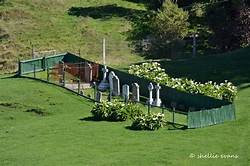
Kuika's grave became part of the small private Kākāpo Bay Cemetery at the present Kākāpo Bay Scenic Reserve, where several members of the Guard family were later buried. This gravesite had become sadly neglected over the years, but in recent times has been comprehensively upgraded by Guard family descendants.

                      Guard Family Cemetery at K
ākāpo Bay, with Kuika's grave at the back. 

 Note:
A number of the whalers had what were known as "Māori wives". Interestingly, Edward Jerningham Wakefield, who as part of his travels in 1840 visited Jacky Guard's whaling station known as Te Awaiti, at Tory Channel, later made the following comment in his book  Adventure in New Zealand, which covered his journeys around the country.
"A very important part of the preparation for the whaling season was providing the party with native wives for the season. Those who remained during the summer were generally provided with a permanent companion".
While Kuika and Kataraina had been officially married to their respective partners by the Rev. Ironside, it seems that a number of these "wives" were in effect "comfort women", regarded as a commodity. This was clearly a common arrangement, made through the various local chiefs in exchange for trade goods, with the women concerned probably having little say in the matter.
The Rev. Ironside confirmed this practice, noting after setting up his mission at Ngakuta Bay that Māori women were traded by their chiefs as temporary wives to visiting seamen in exchange for such as a keg of tobacco, and that these temporary wives sometimes found it difficult to extricate themselves from the persuasions of unscrupulous Europeans.
    
 References

Mitchell, Hilary & John
Te Tau Ihu O Te Waka / A History of Māori of Nelson and Marlborough
Volume 2, Chapter 2, The Coming of  Christianity. See pg 83 for Kuika's story

Chambers, W.A.
Samuel Ironside in New Zealand, 1839-1857, pub. Ray Richards, Auckland, in association 
with the Wesley Historical Society of New Zealand 
Ch 7, Pioneering in Cloudy Bay 1840-1843 pp 101-145. Includes details about Kuika's murder (pg 28) and the aftermath of the Wairau Affray. 

Te Ara Encyclopedia of New Zealand

The Prow website: Stories from the Top of the South

The Prow website: Stories from the Top of the South

National Library of New Zealand blog post

Wikipedia article

See also the book "Guards of the Bay" by Don Grady (pub. 1978), a history of the Guard family, whalers and sealers in the Cook Strait area who founded the Port Underwood whaling station at Kakapo Bay.


Saturday, May 13, 2023

The Day it All Went Down: How Ngatimoti's Peninsula Bridge Lost its Pier


Central pier for Ngatimoti's Peninsula Bridge under construction in 1911. 


The Motueka River has always been a force to be reckoned with, and crossing it a precarious business. For Ngatimoti’s early European settlers, who took up farming on both sides of the river, getting a proper cart bridge established between the east and west banks was a major concern.

A petition for such a bridge was signed in 1880 and presented to the local authorities. A plan was drawn up for a bridge at the Peninsula site, but shelved. Instead a compromise footbridge was built in 1894 at Pokororo, near the confluence of the Graham River. Another bridge was erected at the Alexander Bluff in 1909, linking Pangatotara with the Rocky River/Shaggery area, but a road along the west bank connecting it to the Graham and Pearse Valleys would remain a work in progress for several more years.

Agitation from Ngatimoti residents continued. Finally, in March 1911, after a lengthy process of getting plans approved for a light traffic bridge and loans raised, the Peninsula Bridge build got under way. It was designed to have two spans, with a solid central pier in the river, but after work started on this pier, Mother Nature had other ideas. On the night of September 18, 1911, heavy rain fell in the Motueka district, resulting in a flood almost rivalling the legendary benchmark “Old Man Flood” of 1877. Several labourers working on the bridge build were rudely awakened during the night as the river rose and swamped their nearby camp on the riverbank, causing a hasty scramble in the dark up to higher ground - luckily all made it to safety.

Amongst the collateral damage of swamped homes, wrecked crops and drowned sheep was the central pier of the Peninsula Bridge. From her home on the east bank of the river opposite Greenhill Road, Kate Waghorn, wife of the bridge build’s foreman Frank Waghorn, watched in shock as the pier collapsed, irreparably damaged, under the pressure of the raging floodwaters. Ngatimoti identity Les Waghorn (Frank & Kate Waghorn’s youngest son) recalled that the central pier could still be seen from the river bank when he was a boy and that he and his friends were able to swim out and stand upon it. Over the years since then it has sunk a little further below the surface but has remained both an intriguing lurking presence and hazard to be avoided for the generations of Ngatimoti kids who've dared each other to jump from the Peninsula Bridge into the river below.

Post flood a rapid rethink was in order and a revised plan was drawn up early in 1912 for a single span suspension bridge designed to take a load of 10 tonnes and incorporating the already completed piers at either end. This new plan was adopted and building resumed, with the bridge being opened to great celebration on Saturday, July 7 1913, by the Hon. Roderick McKenzie, M.P. for Motueka. “Saturday was a great day in the history of Ngatimoti and the settlers did full justice to the occasion,” reported the “Nelson Evening Mail” on the day, noting that 27 years had gone by since the original Peninsula Bridge committee had been formed with the aim of getting it built. The ceremonial ribbon was cut by Mrs Anne Brereton, the oldest living West Bank resident, and her son Cyprian Brereton gave a speech, being roundly cheered by the crowd present when he declared in conclusion that the opening of the bridge was “more important to those living on the west side of the river than the opening of the Panama Canal”.

The Ngatimoti community came out in force again for a more recent celebration, held at the Peninsula Bridge on Saturday 6 July 2013 to mark the 100th anniversary of that original opening.

In 1936 the Peninsula Bridge underwent a major overhaul. The wooden superstructure was replaced with concrete and the bridge decking, guard rails and sides rebuilt. Strengthening of the western pier was carried out in 2006, and for those who eye the bridge a tad nervously while crossing, reassurance that it is subject to constant ongoing maintenance work, including the use of a very large spanner to tighten the wire cables!

The comprehensive “Nelson Evening Mail” account of the 1913 opening of the Peninsula Bridge (link below) provides the bridge’s statistics at the end, for those interested in the details. 

References

Opened by Hon. R. McKenzie
Nelson Evening Mail, 7 July 1913, 1913, pg 5

See also

"Nelson Evening Mail", 19 Sept 1911, pg 6
Details the events around the collapse of the central pier at Ngatimoti's Peninsula Bridge.


Acknowledgement
Photograph courtesy of Ngatimoti historian Mr Edward Stevens.

Note that of the labourers shown in the above photo, Thomas Hovenden, pictured standing on the pier structure at top left, is the only one who has been identified to date.

Saturday, May 6, 2023

Daniell Brothers, Alfred & George: Storekeepers at Ngatimoti & Brightwater.


Daniells’ house and store at Waiwhero Road, Ngatimoti, near the present War Memorial Hall, with the Mt Arthur range behind, sometime between 1905-1910.

At centre is Alf Daniell’s new home with attached store, a shed/storeroom (with wide doors front and back so a loaded wagon could drive right through) and recently cleared farmland. Hard to believe this area would become Ngatimoti’s central hub for many years! Across the road to the left is blacksmith Lawrence (Tod) Heath’s smithy. This was situated next to the Orinoco Stream on land belonging to the Haycock family, whose home at the mouth of the Orinoco can be seen further back, directly above the Daniells’ house. The black square up on the slope behind the smithy is likely to be a raspberry crop. Raspberries, along with hops, were widely grown in the Ngatimoti area before tobacco took over as the cash crop of choice. The further clump of trees and shed closer to the hills left of the store are on the Peninsula farm bought from Christopher Remnant Snr by brothers Guthrie & George Beatson in 1903 and still in the Beatson family today.

The youngest surviving child of Henry Cooper Daniell & Anna (nee Lollis), Alfred Daniell was
born in Nelson on 21 August 1855 and grew up at his father’s estate on Brook Street.

Henry Cooper Daniell (1817-1895) came out from England with his wife on the ship “Mandarin” in 1841, their first child, Ann Randall Daniell, being born on board (Ann Daniell, who never married, ran a successful private school on Hardy Street for several decades). Henry was employed as an accountant and administrator by the NZ Company in Wellington, but following the Wairau Incident in 1843, he was sent by Colonel William Wakefield to Nelson to deal with the Company’s accounts there – the death of Nelson’s NZ Company agent, Captain Arthur Wakefield at Tuamarina had left Nelson’s affairs in disarray. A well-regarded and god-fearing man – he was one of the first Baptists to settle in Nelson, later joining the Plymouth Brethren - H.C. Daniell became an Auditor of the Nelson Trust Funds and for many years was Nelson’s Commissioner of Crown Lands. He was appointed a Governor of the first Nelson College Board in 1858.

Alfred’s next-oldest brother George ventured into the hinterlands in the 1870s, when he set up a store in a room at John Taylor’s Hotel at the Baton during the goldrush days. During this time he based himself around Ngatimoti, where he made the acquaintance of various local residents and he and Alfred, like their father members of the Plymouth Brethren, would preach at Dovedale on Sundays. One resident who became a good friend was John Cornwall McGaveston, also a member of the Plymouth Brethren, who farmed at Pokororo, and in 1877 married as his second wife Penelope Dean Wallis. Penelope was the oldest daughter of Richard & Mary Ann Wallis who had set up orphanages, first at “The Gables” on Thorp Street in Motueka, and later at “Hulmers’' on Chamberlain Street, Lower Moutere. George Daniell married Penelope’s younger sister Eliza Wallis in 1880.

Meanwhile, Alfred also became a storekeeper when he bought Herbert Edwin Hall’s general store and property at Brightwater in 1886. It’s notable that among other things, he had the agency for the products – wooden buckets, barrels, casks & churns etc - made by cooper Benjamin Strachan, whose “Manawatane” farm was at the top of Strachan Road in the Orinoco Valley.

In 1889 Alfred married another of the Wallis sisters, Frances Thornton Wallis, the wedding taking place at the bride’s Lower Moutere home, with the Rev. Mr Robert Young officiating. In June 1891 their first child was born at Brightwater but died the next day. Further misfortune followed when later that year Alfred’s business was subject to a mortgagee sale. It appears that his brother George, who may well have already been involved with the Brightwater business, bailed Alfred out and took it over. George’s wife Eliza then ran the store while he himself travelled around the district with a cart selling goods. George & Eliza had 2 children, Edward George, born 1881, who settled in Napier, and Anna Beatrice, born 1888, who never married. George died in 1929 and Eliza the following year. Both are buried at the Waimea West Cemetery.

With George now in charge of the Brightwater store, Alfred & Frances Daniell moved to Ngatimoti. They leased a piece of land at Greenhill from the large Woodstock Estate, owned at that time by Dr Johansen, who had a medical practice in Motueka. There was an existing old house which they made their home and Alfred built a mud (cob) store nearby, set back from the road. This was almost directly opposite the aerial cage on wires leading to the McGavestons’ farm on the west bank of the Motueka River.

Among his customers were a number of “hatters” - the diehard old diggers who came down from the Mt Arthur Tableland and crossed the Motueka River by either canoe or the McGavestons’ cage. Some would also spend the winters working the Motueka River shores at places like “Tin Pot”. They carried gold in little chamois bags which they used to pay for their purchases, including many bottles of the diggers’ perennial favourite, Perry Davis’ Patented Painkiller, a potent brew of opiate-laced alcohol, touted as a “purely vegetable medicine.” These rough-and-ready chaps made Frances Daniell nervous, and when her husband was away she kept her young son at hand whenever they traded with her.

Alfred & Frances Daniell had two more children - Mary Louisa (Louie), born 1892, and Alfred Henry (Harry), born 1894

Dr Johansen died in 1895 and his Woodstock estate was gradually broken up, When the Greenhill block was subdivided and sections auctioned off in 1906, the piece leased by the Daniells became part of the land sold to Matilda Whelan and her son William. This upcoming subdivision prompted the Daniells’ move around 1905 to the site near the intersection of Waiwhero Road and the Motueka Valley Highway, a 39 acre block (Pt Section 22, Block X, Motueka Survey District) taking in the land right down to the current Memorial Hall site, bought from Guy Beatson (a cousin of the Peninsula Beatsons), who then bought one of the Greenhill sections for himself.

Alfred had a demanding weekly schedule. He would leave home first thing in the morning with a list of orders from local customers, travelling with his covered express drawn by two horses through Orinoco and Rosedale, along the way collecting butter and eggs and lists of orders from the large purpose-built boxes placed at farm gates. At Upper Moutere he stopped to rest his horses and have a cup of tea, reaching Nelson in the evening. He would stay a night or two at the family home in the Brook – three unmarried sisters lived on there after their parents died - while he sold the farm products in Nelson and stocked up with the groceries and other supplies requested by his customers. He would then drop these off at the appropriate farm gate boxes on his way back home.

Daughter Louie, who never married, took over the shop as she grew older, while son Harry worked on the farm, and they carried on after Alfred’s death on 21 January 1920. He was buried at the Waiwhero Cemetery.

Around 1923 the Ngatimoti School, at that time up on the hill just past St James Church, was looking for a more central site. Some land was purchased from Mrs Daniell and a new school was built near the later Memorial Hall site. This school ran from 1924 till 1954, when the Ngatimoti School moved to its present site at Greenhill, formerly the 5 acre retirement block known as “Rathgar” belonging to Daniell in-laws John & Penelope McGaveston, and just a short distance from Alf Daniell’s first store at Ngatimoti.

Frances Daniell advertised the rest of the Daniell property for sale in April 1924 – farm and general store with house, shop and storeroom on 36½ acres of land– but it seems there were no takers.

After the second Ngatimoti School opened next-door, Daniells’ store housed the local library (previously kept at the first Ngatimoti school) and also the Ngatimoti Post Office, which operated from a small room attached to the house, next to the store. Louie Daniell took on an extra role at this stage as postmistress. Mother and daughter were a local institution - Louie presiding with due dignity over the Post Office or miraculously conjuring up required items from the jumble of miscellaneous goods stacked on the store’s shelves, while Frances, increasingly crippled by arthritis, sat in her accustomed place on the verandah, where she could see what was happening along the road and chat to customers as they came in. Tod Heath moved his home and business to the site of the current WWII Memorial Hall, then a corner of the school grounds, which would be situated to the extreme right in the above photo. He leased land nearby where he grew tobacco and had two tobacco kilns behind his forge. With cars growing in popularity, he had a couple of bowsers dispensing “Big Tree” benzene set up outside his smithy.

Harry Daniell, who married Beatrice Marker in 1924, had moved to a farm in the Lloyd Valley by 1928. Frances Daniell died in 1937 and was buried at the Waiwhero Cemetery with her husband, Alfred.

Louie Daniell retired as postmistress the following year and retired to Nelson. Her brother moved back to the family home and the post office carried on regardless at the Daniells’ old store, with a succession of local women serving as postmistress.

A further part of the Daniells’ property then passed to local carrier Percy Tomlinson and his wife Grace (nee Mytton). In 1941 Percy built a separate new store just a few metres further up Waiwhero Road, next to the yard from which he operated his freight company, “P.N. Tomlinson”. The Ngatimoti Post ffice then moved to the new store, where it ran from its own small, attached room, Percy was appopinted postmaster, with an assistant, Jack Harris, who when the Tomlinsons moved on took over as postmaster from 1948-1973. A telephone exchange was added nearby, a telephone box set up outside and a couple of petrol pumps put out front. In 1957 the Tomlinsons sold their business to Transport Nelson Ltd, who established their Ngatimoti depot at Percy’s yard. TNL then had their own depot office attached to the store, which carried on under the management of Harrie & Carol Peters.

All these services gradually dropped away. Tod Heath retired to Motueka in 1941 and the Memorial Hall took the place of his former home and smithy in 1954, the same year that the Ngatimoti School made its third move to its current site at Greenhill. The Ngatimoti store closed in 1966, as locals were by then driving into Motueka to do their shopping, TNL shut its Ngatimoti depot in 1970, and the Post Office, the last to go, closed up in 1978. All that remains now are the former telephone exchange building (latterly the Ngatimoti Bowling Club rooms) and Perce Tomlinson’s old store, still on its original site. It has over the years been used for various purposes including a woodturner’s workshop and in 2009 a briefly revived general store, but more often than not has stood empty, a lonely testament to a once busy past.

And for those wondering, the Daniells' house became a private home after Harry Daniell left Ngatimoti - it wasn't part of the property bought by Percy Tomlinson. Situated at what is now 1016 Waiwhero Road, it is still in use 114 years after it was built, despite having been swamped during a major flood in 1957. It has been through a number of owners since the Daniells departed, including Laurence (Laurie) Barnes and his son, Alan & Veronica Hall, who raised it up just in time to avoid being swamped by a later flood in 1983, and latterly by Norman Carrington & Linda Sillery.


Acknowledgement
Photo courtesy of Mr E. Stevens, ex T.B. Beatson Collection, Motueka & District Historical Association.


Thursday, January 12, 2023

Thomas Rae (1809-1849): From High Hopes to Hallowell

Image believed to be that of the "Prince of Wales",
the Aberdeen-built barque which brought the Rae family to Nelson, New Zealand in 1842.


Thomas Rae (surname sometimes alternatively spelt Ray or Rea) was born in Scotland around 1809. He settled at Forfar, in the county of Angus, where he worked as a farm labourer. Times were hard, and it’s likely that Thomas and his family fell victim to the Scottish Clearances, which saw landowners turn from traditional labour-intensive agriculture and instead enclose their land for sheep farming. Hundreds of rural workers were made redundant and evicted from their cottages, which were usually tied to the farms where they worked. Large numbers of Scots dispersed all over the world during this period, by preference to British colonies.

The New Zealand Company's agents were active in the stricken Lowlands counties and perhaps their efforts persuaded Thomas to take the momentous decision to emigrate to the far side of the world. In search of a better future, the Rae family joined the exodus from Scotland. Having made their way to London, on 2 September 1842 they set sail on the barque “Prince of Wales”, under the command of Captain Alexander and heading for Nelson, New Zealand. On board were 43 cabin passengers and 158 emigrants travelling steerage. Among the latter were listed Thomas Rae (aged 35), his wife Agnes nee Duncan (30) and their children, William (12), Elizabeth (10), Margaret (7) and Robert (4).

The voyage was a relatively smooth one, lasting 110 days, this being considered a very good passage. The “Prince of Wales” arrived in Nelson on the 31st December 1842, but sadly, the Raes were by then down by one. Agnes, wife and mother, had died during the voyage, leaving her family bereft.

Family legend says that the ship was met by Henry (Snr) & Mary Redwood, who had heard of the Raes’ loss and wanted to offer their help. The Redwoods, who became well-known Waimea West pioneers, had arrived on the “George Fyfe” on 12 December 1842, just 19 days before the Raes. I myself, though, believe that this charitable family were the Scottish Kerrs, given that both Elizabeth & Margaret Rae later named daughters after Mrs Kerr, and that their father Thomas appears to have been working for the Kerr family at Waimea West.

 It has become clear that the Rae children were taken into the care of the Kerrs, another hospitable family of early Waimea West settlers, who were fellow Scots - John Kerr Snr and his wife Janet nee Ramage. Mrs Kerr was much esteemed for her generous nature and both the Rae sisters later named daughters "Janet Ramage" after her.

Further misfortune followed for the young Raes. Their father Thomas Rae died suddenly on 20 March 1849, just seven years later. He was only 40 years old.

It had been believed by descendants that Thomas had drowned crossing a river while going to visit his children at the Redwoods' property. This could have been a possibility, given that it os well known that his son Robert worked at the "Redwoods Stables" and it's possible that Robert's older brother  William had also worked there. However a heart attack is given as the official cause of  Thomas' death. His registration of death certificate has his name as Thomas Ray and this is how he appears in cemetery records. The detail on the registration document is pretty light, unfortunately, but does tell us that he was at the time of his death a labourer at Waimea West. The Rev Henry Francis Butt recorded as the informant in the case of Thomas' death was an early Nelson Anglican clergyman associated with St Michael's Anglican Church at Waimea West, and this fits with my assumption that Thomas was living in the area and was connected with the Kerrs. I think it likely that Thomas Rae had in fact been working for them since his arrival in Nelson, especially given that the Kerrs' homestead was sited almost opposite St Michael's.

Since at the time St Michael's didn't have a cemetery, Thomas was buried at Nelson’s oldest cemetery, Hallowell, off Shelbourne Street, a former Maori urupā (burial ground). The actual site of his burial is unknown, but Thomas’ name is recorded on a commemorative board at the cemetery listing the names of known burials there.

It seems very likely that the two Rae sons, William and Robert (who both later went alternatively by the surnames “Reay” and sometimes “Ray”), also lived with the Kerrs at Waimea West until old enough to find work.  It's possible that both sons worked for Henry Redwood, firstly at his Redwood Stables at Waimea West and later at his "Chokebore Lodge" stables at Riccarton in Christchurch.

In 1860 William Reay was married in Christchurch to Mary Ann Pickering, a daughter of William Pickering and his wife, Susanna (Susan) nee Kite, who had settled  at Richmond, Waimea East, around 1856.  William and Mary  Ann Reay later moved from Christchurch back to Richmond, where they lived with their family of four in a home next to the Oddfellows Hall. William then worked as a roadman for the Stoke Road Board. but sadly, he later fell prey to depression and on the 9th of October 1895, he took his own life whilst under the influence of alcohol.


His younger brother Robert Reay (known as Bob), was taken up as a protégé by Henry Redwood of “Redwood Stables”, Waimea West, after showing an early talent for riding and racing horses. Horse racing was hugely popular as both a sporting and social event during the early decades of Nelson’s settlement, and as a rider of note, Robert raced horses for a number of Nelson bigwigs at events like those held at the Stoke Racecourse, on land  opposite the Turf Hotel; the Great Nelson Trial Stakes, and the Waimea South Steeple Chase based around the Wakefield Arms hotel.  By 1870 Robert had moved to Christchurch, where he worked as a rider and horse trainer, becoming a well-known figure in the Canterbury racing industry based around the Riccarton Park Racecourse.   He married Charlotte Higgins in 1872 and they had four children, with the oldest son, Robert Henry, later taking over his father’s horse training business.  An obituary published in the “Press” following his death on 23 April 1905 listed  Bob Reay’s achievements, describing him as “A Veteran of the Turf”.


Thomas & Agnes Rae’s daughters Elizabeth and Margaret (Maggie) Rae both married in 1855 - Margaret to Robert Hooker and Elizabeth to John (Jack) Kerr Jnr. Hooker and Kerr were at the time business partners in a butchery business on Bridge Street in Nelson, and now became brothers-in-law as well.

The following year John Kerr and Robert Hooker both moved further into Wamea South – Kerr running the Tarndale Station (later sold to William Acton-Adams) before moving in 1862 to Lake Station at Lake Rotoiti, while Hooker first managed then bought the lease from William Gordon Bell for the Gordon Downs Run, and was also granted a licence to build and run the Gordon Downs Accommodation House (also known as the Upper Motueka Hotel) at the ford near the site of the current Jansons' Bridge in the Wai-iti area.

Between them, the Kerr-Hooker family group held a useful chunk of the accommodation and supplies business on the Buller route – Robert Hooker at Gordon Downs, and brothers David Kerr at “Blue Glen” run near the top of Kerrs’ Hill on the Nelson side and John Kerr at Lake Station on the Buller side, with Tophouse in the middle run by various owners. For many years “Gordon Downs” and “Blue Glen” remained important stopovers for drovers taking stock through to Canterbury for sale at Addington, though the Hookers had moved on by the 1870s. 
Robert Hooker sold out in 1864 when he bought George Duppa’s former Allington estate just outside Brightwater and in 1866 took over the management of the Belgrove Hotel. Margaret Hooker nee Rae died at Wakefield in 1874, and her husband moved to the North Island. Her sister Elizabeth Kerr nee Rae died in Nelson in 1904, her husband having predeceased her in 1898 when he accidentally drowned at Lake Rotoiti.

One of Elizabeth Kerr's daughters was named for her sister and she was also known as Maggie. The Maggie and Maud Creeks at the Howard goldfield were named for Maggie Kerr and her sister Maud, who married Motueka merchant, Henry James (Harry) Rankin.
I