Friday, July 16, 2021

Boom and Bust: The Road to Owen Reefs.


View of the new road to the Owen Reefs, with Mount Owen in the distance and roadmen’s camp in front. Stumps of felled trees mark the line of the road. Sketch by E. Butler, mining engineer, Oct. 20th, 1886. Credit: Alexander Turnbull Library, Ref. A-443-021

Leases to the left of them,

Leases to the right of them, 

Leases in front of them, 

Surveyed and numbered,

Out of the swarm of names, 

Good for sharebrokers’ games,

What will prove paying claims -

One in a hundred?"


“Taking a liberty with Mr Tennyson’s 'Charge of the Light Brigade'”’

The “Nelson Evening Mail” has a satirical poke on 3 March 1882,

at the all-too familiar boom & bust nature of gold mining.


In 1860, while Julius von Haast was conducting a topographical and geological survey of the Buller and Grey Valleys at the behest of the Nelson Provincial Government, he encountered the range known now as the Marino Mountains, included within the present Kahurangi National Park in North-West Nelson. As was the habit of European explorers in colonial times, he took it upon himself to give the tallest, triple-peaked massif a name, calling it "Mount Owen" in honour of renowned English paleontologist Sir Richard Owen. He also gave the name "Owen" to the river running through the valley at the mountain's foot. He and his party looked for but found little signs of gold in the Owen River, though from his observations of the Buller and Owen Valleys from the top of another mountain, which he named Mount Murchison after geologist Sir Ronald Murchison, Haast noted that he thought an easy road could be made through by the way of the Wangapeka and Owen Rivers, and it's believed that a number of diggers did in fact later track their way to the goldfields along this route.


On 16 January 1864 the “Nelson Examiner” remarked upon the possibilities of rich gold-bearing quartz reefs around Mount Owen after a specimen of quartz and conglomerate containing a large percentage of gold was brought from the area and displayed in Nelson. Interest at the time, though, was focused on the more easily accessible alluvial gold to be found around the four rivers near the future Murchison settlement in what is today the Tasman District - the Buller, Matiri, Mangles and Matakitaki. However, the discovery and subsequent mining of extensive quartz reefs around Inangahua and Lyell in the 1870s led to a renewed interest in the Owen. The hunt for auriferous quartz was on, led by prospector Charles Bulmer (for whom Bulmer Creek was named), whose explorations resulted in the discovery of quartz reefs on the south-east slopes of Mount Owen around 1879-80.


In February 1882 Bulmer and his partners, Matthew Byrne of Lyell and Joseph Gibbs of Longford, made a formal application for a claim some 12 miles from the junction of the Owen and Buller Rivers. Getting into the rugged site was particularly difficult, and with trial assays of ore proving positive, by 1885 various of the other syndicates which had popped up - Wakatu, Uno, the Bonanza Quartz Mining Company, Owen Quartz Mining Company, The Zealandia, Broken Hill, the Enterprise, Lyell Quartz Mining Company, Golden Fleece, Comstock, Golden Crown, and Southern Star - were making applications for mining leases and clamouring for better access. 


In March 1885 a delegation from the syndicates met with the Hon. William Larnach, Minister of Mines, in hopes of securing a Government grant for the construction of a road good enough to transport supplies and machinery up to their various claims. They presented a report prepared by Mr E. Butler, a specialist in the field of underground engineering hired to draw up plans for and supervise a number of tunnelling projects around the Owen quartz mines. Larnarch concurred that the situation looked promising and agreed to facilitate some funding for a road if it could be freed up, though it appears the forthcoming amount was less generous than anticipated. Still, with Government backing, creating an access route was now possible. 


A road along the Owen River was initially under consideration, but Jacques Ribet, proprietor of the Hope Junction Hotel and a partner in the Golden Fleece syndicate, jumped the gun and made a start on what he described in a letter to the Editor of the “Nelson Evening Mail” of 8 Jan 1886 as “a fair pack-track” over a low saddle to the Maggie Creek. This would run up the Owen Valley from the junction of the Nelson and Buller Roads which became known as “Owen Junction” (Note: this junction was where “Glenview Farm” is situated on today’s Kawatiri-Murchison highway. It should not be confused with the junction of the Owen and Buller rivers where the Owen River Hotel stood, which was known as the Owen River Junction)  After much bitchy wrangling over the pros and cons of the two routes, it was decided to make a dray road along Ribet’s track and a great deal of equipment would later be waggoned in along it, including timber for building, fluming and the machinery needed for the big stamper batteries at the Enterprise and Wakatu claims, used to crush the quartz as part of the gold extraction process.


Veteran surveyor and back-country roadmaker Jonathan Brough was appointed by the Public Works Department as overseer in charge of the road work. Butler’s pencil and charcoal drawing of the road under construction shown above was given to Brough by Butler and passed down through Brough’s family. 


The story goes that Brough, who had himself worked as a digger in both New Zealand and the Victorian goldfields, had little faith that Owen Reefs would be a success and quietly discouraged friends thinking of investing in the venture.


With the road issue now sorted, throughout 1886 it was all go at Owen Reefs. In January applications went in for a number of mining licences and machine sites and by February work was underway at the Bulmer Creek, Uno, Wakatu and Golden Fleece claims, while Golden Crown, Golden Point and others were awaiting survey. Government mining surveyor, William C. Wright, was busy conducting a mining survey and drawing up plans for the Owen Reefs township, well up the Owen Valley above Brewery Creek and complete with streets named Bulmer, Byrne and Battery. A smaller informal settlement sprang up near the Wakatu mine workings. 


Wright’s comprehensive map of the Owen area, dated 1 June 1886, details mining and geological features around Owen Reefs, along with tracks and roads then in use and accommodation house sites en route, and can be seen at the Alexander Turnbull Library in Wellington. 


A number of miners nearby with claims at the Bulmer Creek/Owen River junction, panned for alluvial gold to tide them over as they waited impatiently for the road to be completed. By September the road had reached as far as the 3000 acre Owen Run in the Owen Valley, owned by Samuel Baigent of Wakefield but run by manager Dave Curran, where plans were afoot to plant a large vegetable garden to feed the new township. At this point contracts were let for the remaining 9km of road - 27 shillings & sixpence a chain (20.1168m) for side cuttings and seven shillings & sixpence a chain for clearing bush and stumping on flat land being among the going rates offered. It must have been around the time of this final push that mining engineer/surveyor E. Butler drew his sketch dated 20 October 1886. 


The following day, 21 Oct 1886, was celebrated as a red letter day for the mining enterprises, the first dray, with six ctw (304.81kg) on board, having been driven successfully to Owen Reefs through the new road. Comment was made that Mr Jonathan Brough, the overseer in charge of the works, was doing his level best to make the road passable with the limited means at his disposal.


Little gratitude was expressed when the road was finally finished, miners and travellers alike (a visit to Owen Reefs soon becoming a popular attraction for the more adventurous tourist) excoriating it as “diabolical”, lacking adequate gravel coverage in wet weather and requiring a number of boggy patches to be corduroyed with logs before a dray could be safely driven over them. Reading between the lines, this was probably the result of skimped funding, though no doubt original advocates of the Owen River route would have been quick to point out that a ready supply of gravel along the river track and the large amounts of sticky yellow clay and swampy ground along the Ribet route were why they had objected to the latter in the first place. Packing charges were another favourite subject for complaint, being regarded as little more than daylight robbery. 


September 1886 had seen a flurry of hopeful locals applying for accommodation and liquor licenses at places along the way likely to make the most of the expected rush to the area, and also at sites closer to the Owen Reefs township itself, like Thomas Tattershall at Bulmer’s Creek and Myles Dixon at Flowers Flat. Among others were George Henry Trower, who had taken over the Owen River Hotel, while Irishman Michael Fagan established a two-storeyed accommodation house, called the Owen Junction Hotel but better known as 'Fagan's", at the Owen Junction. Newmans’ coach service then added regular stops there on its twice-weekly Nelson-Westport return run to exchange mail and pickup/drop off passengers. Fagan’s brother-in-law, Henry O’Loughlen, who was running an accommodation house at the Owen Reefs township, was appointed the Owen Reefs’ postmaster and would ride back and forth to Fagan's by horseback to deliver snd collect the mail. 


Jacques Ribet of the Hope Junction Hotel (situated about 4 km down river from the old Kawatiri railway terminus site) was their father-in-law and had quite a chunk of the accommodation business in the area tied up within the family at the time - yet another son-in-law, Alfred (Alf) Smith, was then running the Fern Flat accommodation house.  


Michael Fagan put his Owen Junction Hotel up for sale in 1887, but it hadn't sold before both he and his wife Rowena died within months of each other in 1888, just two years after moving from their farm at Grassy Flat to live at Owen Junction. Their accommodation house passed around 1890 from Fagan’s executor, Jacques Ribet, to blacksmith George Edwards, who ran it with his wife Elizabeth and added tearooms to the facilities there. It was then run by the Edwardses’ daughter Rosina and her husband, Michael Dwan. After standing on site for many years, the former accommodation house, known locally as the "Old Coach House", was eventually deliberately burnt down by a later owner, who built a new house at a different site on the property.  


After the Owen Reefs Post Office closed in 1890, postal services were transferred to George Trower's Owen River Hotel at the Owen River Junction. Both hotel and post office then underwent a simultaneous name change.


This was the first of two moves for the Owen Reefs Post Office, both times to a place called Owen Junction, and the start of ongoing confusion around the name and site of Owen Junction. A puzzle which has taken time and patience to untangle, and if anyone has found a better answer, please let me know!


In 1890 when the post office made its first move to Trower's Owen River Hotel, the late Michael Fagan's Owen Junction Hotel had just changed hands, and was now known as Edwards' Accommodation House. The Owen River Hotel then took the name "Owen Junction Hotel" for itself. The former Owen Reefs Post office followed suit, becoming the "Owen Junction Post Office" at the "Owen Junction Hotel". The Owen River Hotel then kept the name Owen Junction Hotel for a number of years. However, by the time the new inn built sometime after 1925 on its current site by then proprietor Len Newman was badly damaged during the 1929 Murchison earthquake (much to the dismay of tired and hungry parties trying to make their way through from Nelson to assess the damage), it seems that it had since become known once again as the Owen River Hotel. And although Len Newman had renamed his repaired inn the "Owen River Tavern", officially it remained the 'Owen River Hotel" in Motueka Licensing Committee records.


The Post Office's second move came in 1898, after Trower put his hotel on the market, and it was shifted again, this time from the Owen Junction Hotel at the Owen River Junction to Robert Win's property at the "other" Owen Junction at the intersection of the Nelson and Buller roads. There the post office was set up at a site just across the road from Edward's Accommodation House, originally named the Owen Junction Hotel by Michael Fagan in 1886. 


Keeping the name Owen Junction Post Office after this move (no need for a change this time), the post office was then run at Win's for several decades from a building which had previously been the powder magazine attached to the Enterprise syndicate’s workings at Owen Reefs, hauled out down that troublesome track to Owen Junction on behalf of the NZ Post & Telegraph Department. Two generations of Wins served as postmasters there - firstly Robert Win, then his son Dudley.


During 1887 work and development continued at the mines, with eager speculators bringing in further funds, confidently expecting successes on the scale of those at Lyell and Reefton. In 1888 crushing began and gold fever excitement reached its peak, but the amount of gold extracted proved depressingly small. Regrettably, no notice had been taken of surveyor W.C. Wright’s earlier warnings that Mount Owen quartz was in huge blocks, more difficult and costly to work with than the usual continuous reefs, and that prospectors would be wise to take up extended claims.


And so, alas, despite all the high hopes and early promise, the Owen reefs proved a sad disappointment, with many of the syndicates and their members suffering disastrous losses as a result. Among those affected were coaching pioneers Tom & Harry Newman, who had pushed out the boat to purchase suitable heavy horses and waggons for the job after being contracted by an English syndicate to transfer all the gear they had purchased for crushers and stampers from Nelson to their mine near Owen Reefs. However, the ever-enterprising Newman brothers then put these waggons and horses to work by setting up a successful Nelson-Murchison freight run.


Although a substantial amount of silver was mined and exported, the going price being paid for it at the time was low. Without gold to fund it, the Owen Reefs’ venture was a bust. By 1890 the mines had closed down and the miners, storekeepers, brewer, butcher and publicans had moved on, leaving buildings and machinery behind. Exceptions were the Enterprise’s powder magazine, repurposed as the Owen Junction Post Office, and Wakatu’s big stamper battery, which was taken to Wakamarina for use at the reefs there.


Regardless of evidence to the contrary, the existence of a “lost lode” of gold remained a persistent rumour, though to date no one has found it.


Interestingly, in 1890 David Norris from Murchison, a man with much back-country experience and a knowledge of minerals, was hired by a company to investigate why the rich gold seam near Mount Owen had so suddenly petered out. He spent 6 years altogether tramping and climbing around the Mount Owen area working on this project, concluding in his final report that in ages past a big upheaval had broken layers of stratum off, to drop a thousand feet below, and that the gold seam had gone in like manner. He initially took his family with him and for the first 2 years they lived in one of the empty hotels at the abandoned Owen Reefs township. Life for the Norris family during this stage was later recorded by David Norris’ daughter Frances Jane, and her memories of that time are recounted in Jeff Newport’s book “Footprints Too”.


The name Owen Reefs vanished from the maps, the area becoming known instead as Owen Valley and the land on which the township had been built later became part of a settler’s farm. What of that hard-won road? In 1905 the Owen Valley was opened up for settlement by farmers, and twenty years later a new road was built along the line of the Owen River to service the area - too late for those who had argued for that route back in the 1880s. It was named "Newman’s Road" for popular local identity Len Newman, who ran the Owen River Hotel for nearly 30 years and was much involved in local affairs. This was the only road in use from that time. By the late 1940s it was noted that over time the old road had become almost completely obliterated. 


*****  


Acknowledgements 

Murchison historian Theresa Gibson, for her interest and helpful information received.

Dr Nigel Newman, for making available online his thesis "Mineralization at Mount Owen, central Nelson", and for introducing me to the delightfully apt piece of doggerel published in the "Nelson Evening Mail" quoted at the beginning of this post.


Links to some interesting descriptions of visits to Owen Reefs during and after its brief heyday


“A Trip to the Owen Reefs”

“Colonist”, 1 April, 1887, pg 3


Indefatigable Nelson correspondent “Voyageur” made a visit to the Owen Reefs in 1887 and the account of his journey from Nelson, titled “A Trip to the Owen Reefs”, was published as a series of articles in Nelson newspaper, the “Colonist”. I’ve added a link here to the episode which describes his trip along the new road from Owen Junction up to Owen Reefs.


A Trip to the Owen Reefs

"Westport Times", 16 Nov. 1886, pg 2


"Correspondent" detailed his trip through to the Owen Reefs a bit earlier, when the road was still under construction. He mentions many people and places of interest along the route and describes the Owen Reefs village, where he stayed at surveyor William Wright's camp. A number of names once familar around the Murchison area appear in this article, including those of local accommodation house owners - "Correspondent" was clearly fond of his tucker and a drink or two!


"Plant Hunting on Mount Owen", by W. Townson

"NZ Illustrated Magazine, Vol. 1, Issue 5, 1 Aug 1902.


Despite some paragraphs becoming confusingly misplaced in the digitisation process, this is fascinating account of a botantical expedition in the Mount Owen area. It describes a look around the by then decayed Owen Reefs township in the Upper Owen Valley, the two travellers putting up for the night in a room at the old "Enterprise Hotel" which still had windows.

Note that the "Myles Nixon" mentioned would have been Myles D. Dixon, who was granted a licence for an accommodation house at Flowers Flat, Owen Reefs, in 1886.


Other articles of interest


Owen Reefs District

"Lyell Times & Central Buller Gazette", 10 April 1886, pg 2


Describes work going on around the mines and mentions that "Mr Jackson of the Public Works Department "has just completed a survey of the road into the reefs, the total distance being about 10 miles (16.09 km)", describing the chosen route in detail.


Owen River

"Nelson Evening Mail", 11 November 1939, pg 4


A history of the Owen River Hotel (for a while also known as the Owen Junction Hotel) at the junction of the Buller & Owen Rivers


Applications for accommodation house licenses relating to the Owen Reefs development.

"Lyell Times & Central Buller Gazette", 9 October, 1886, pg 3


The Owen Reefs: Mr Wright's Report

"Nelson Evening Msil", 31 July 1886, pg 3


Owen Reefs  


Click on the above hyperlink to see the plan for the Owen Reefs township drawn up by mining surveyor W.C. Wright, along with a description of life at the township once completed, in a short article made available online as part of the Murchison Museum’s Flashback series.


Opening Quotation


"Taking a liberty with Mr Tennyson".
A satirical poem poking fun at gold fever madness.
See: "Reefton"Nelson Evening Mail, 3 March 1883, pg 2


Sources consulted

Brown, Margaret C. (1976) "Difficult Country: An Informal History of Murchison". 
Pub. Nelson, NZ: R. Lucas & Son (Nelson Mail) Ltd.

Grigg, John .R. (1947) "Murchison, New Zealand: How a Settlement emerges from the Bush".
Pub. Nelson, NZ: R.Lucas & Son (Nelson Mail) Ltd.

Newman, N.A. (1979) "Mineralization at Mount Owen, central Nelson". Thesis submitted by the author to the University of. Canterbury. Can be read online as a PDF.

Newport, J.N.W (Jeff) (1962) "Footprints: The story of the settlement and development of the Nelson back country districts". Pub. NZ: Whitcombe & Tombs Ltd.

Newport, J.N.W. (Jeff) (1978) "Footprints Too: Further Glimpses into the History of Nelson Province". Pub. Blenheim, NZ: Express Printing Works".

Startup, R.M (Robin) (!975) "Through Gorge and Valley: A History of the Postal District of Nelson from 1842". Pub. Masterton, NZ: R. Startup for the Postal History Society of New Zealand. 

The Prow website: Stories from the Top of the South.
Note that Jacques Ribet, a Frenchman by birth, was also known by the names "John" and "James".

Historic NZ newspapers digitised courtesy of the National Library of NZ


Thursday, November 12, 2020

"Rathgar House": Ngatimoti's school hall and the McGaveston connection.


John Cornwall McGaveston
Born at Rathgar, Co. Dublin, Ireland,  1 January 1844
Died at Ngatimoti, Tasman, New Zealand, 13 May 192
5


On 20 September 1850 the ship "Mariner" arrived in Nelson, having sailed to New Zealand from London on 4 April 1850 with 172 passengers on board. Among them was Irish widow Margaret McGaveston nee Page with her two young sons, John Cornwall, aged 7, and 5 year old Charles Wynn. It was not the first sea voyage for the two little boys, who had accompanied their mother in 1848 when she sailed to India to sort out her late husband John Wynn McGaveston's affairs there - he had been a medical officer with the Hon. East India Company serving with the 2nd Bengal Artillery in India, but had died at Rathgar in 1846, not long after his retirement. Having qualified as a surgeon in Ireland in 1823 he had joined the army at Rangoon by the time war with Burma broke out in 1824. 

Margaret McGaveston had travelled on the "Mariner" under the protection of  the Rev. Robert John Lloyd from New Ross, Co. Wexford. Although posing as a married couple, they did not in fact get married  until soon after their arrival in Nelson - their  marriage taking place in Wakefield at the Wakefield Church on 19 November 1850. Both her own family and her McGaveston in-laws had had their doubts about the Rev. Lloyd, but Margaret McGaveston could not be dissuaded from the relationship and cut off any communication with them. Unfortunately, they were right to be concerned. It soon became clear that the Rev. Lloyd had found Margaret's inheritance from her first husband to be her most attractive feature and it appears that her life with him became an increasingly unhappy one. 

The couple started farming in Riwaka, and John and his brother Charles soon acquired a half-brother, Bartholomew, born at Riwaka on 19 June 1851. Known as Barty,  he inherited "Sandy Cove" after his father's death in 1875, and was the oldest of the 3 surviving children born to the Rev. Lloyd and the former Margaret McGaveston. In January 1877 John McGaveston would go to the Motueka wharf with Barty to greet another Irish family who  had just arrived - William & Ann Brereton, their children, and Mrs Brereton's sisters Letitia and Lizzie Bridge. They were taken to Barty Lloyd's Pangatotara home,  where they were very nearly drowned during the ferocious storm which hit the Motueka Valley between the 6th and 7th of February, 1877,  resulting in a benchmark inundation which became known locally as the "Old Man Flood".
 
Another of Ann Brereton's sisters, Matilda (Tilly) Whelan nee Bridge, later came out from Ireland with her children to join them at Ngatimoti after being widowed in 1889. The Rev. Robert Lloyd was Mrs Brereton's maternal uncle, and in 1880 his son Barty Lloyd married his cousin Letitia Bridge. Cyprian Brereton would later write about the Breretons, Lloyds, Whelans and McGavestons in his book "No Roll of Drums", the stories of Ngatimoti's pioneers.

John's younger brother Charles was killed in 1855 after being gored by a bull, and his mother died at Riwaka in 1859, leaving John the only remaining member of the small family which had emigrated to New Zealand. He had been witness to this mother's mistreatment and did not get on with either his step-father or half-brother, Barty, so this was a lonely and difficult time for him, An unconfirmed family story has it that after his mother's death he was so unhappy that he ran away to sea for a time. 

It's likely that the turning point for John McGaveston came when he met Ngatimoti settler John Park Salisbury, who around the same time that John was building a house at Pangatotara was also building a home in the same area for his wife, Clara nee Deck. Clara was a daughter of Plymouth Brethren evangelist James George Deck, who had settled on a farm in the Waiwhero Valley between Lower Moutere and Ngatimoti (still in existence and now known as The Lodge at Paratiho Farms)  James Deck had soon became an influential force in the area and converted a number of settlers to the Brethren cause, including John Salisbury. It's very likely that it was through a connection with John Salisbury that John McGaveston also joined the Plymouth Brethren, a move which brought new purpose to his life.

Over the years John  married twice and with 18 children to his credit, became patriarch of his own McGaveston clan. John was married firstly by the Registrar at Motueka on 23 December, 1862 to Mary Ann White, daughter of Riwaka settlers David White and his wife Sarah (nee Jenkins), originally from Alton, Hampshire, in England. He may well have met Mary Ann through her brothers, George and David White Jnr, with whom he is known to have served in the No 5 Company of the Motueka Militia in 1860,  Mary Ann's older sister, Elizabeth White, had married  in 1862  to  sawyer Joseph Dale Knowles, whose Pangatotara property (still owned by his descendants today) adjoined "Sandy Cove". Mary Ann had 9 children but on 8 September 1876 she died giving birth to a 10th baby, which didn't survive. She was buried at the nearby Pangatotara Cemetery, which was washed away the following year by the "Old Man Flood".  

On 3 October 1877 John was married secondly at Wakefield to Penelope Dean Wallis, whom he possibly met through his connection to the Daniell brothers  who at the time appear to have also been members of the Plymouth Brethren. Penelope was singularly well qualified to take on a large family of step-children, added to over time by her own brood of eight. As a daughter of Richard Wallis and Mary Ann Lake Wallis, who ran orphanages at both "The Gables" on Thorp Street in Motueka and then at "Hulmers" on Chamberlain Street, Lower Moutere, Penelope had grown up looking after many younger children. 


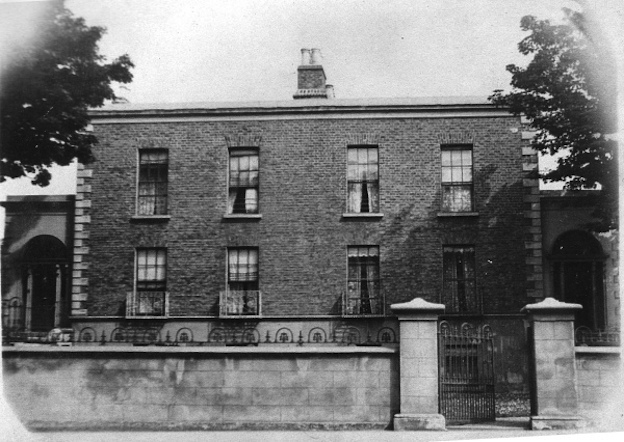
"Wallingford House", Rathgar, Co Dublin",John Cornwall McGaveston's birthplace


                                     "Wallingford House", Rathgar, Co. Dublin, Ireland.


John Cornwall McGaveston was born in Ireland at "Wallingford House, Rathgar, County Dublin, Ireland, on 1 January 1844, being the first child of Dr John Wynn McGaveston and his wife Margaret nee Page. Dr McGaveston was a surgeon in the service of the Honourable East India Company's military branch, attached to various regiments in India, Afghanistan and Burma (now Myanmar), but he retired a year after his marriage in 1842 and returned to live permanently at his home in Ireland. Although established in Ireland by the 18th century, the McGaveston surname is thought to have its roots in Gascony, and is linked by family legend to Piers de Gaveston, an English nobleman of Gascon origin who came to a sticky end at the hands of jealous rivals after becoming a favourite of King Edward II of England. Gaveston did spend time between 1308-1309 in Ireland after being appointed the King's Lieutenant in that country and was rumoured to have had an illegitimate son from whom the present McGaveston line was descended. Although this connection seems likely, it has not as yet been definitively proven. John's second name was a nod to Gaveston's title, the 1st Duke of Cornwall, and "Piers" is another name which often appeared in the McGaveston line.

 Before his marriage, Dr McGaveston was already living at "Wallingford House", a rented home situated on Rathgar Road in Rathgar, then a small village on the outskirts of Dublin, but now a suburb of Dublin City.  He shared it with his brother Nicholas McGaveston and Nicholas' wife Catherine, a good arrangement as until 1842 he was often away in India.  After their wedding in 1842, Dr McGaveston's bride Margaret joined the household, and this is where their two sons were born. Dr John Wynn McGaveston retired from service with the Indian Army at the time of his marriage and died at his Rathgar home in 1846.


"Rathgar" No 1, Pokororo, West Bank, Motueka Valley (later known as "Riversdale")


                                Copy of a photograph of the McGaveston home block taken by 
                             John Edward Salisbury, son of John Salisbury and Clara nee Deck,
                                  neighbour and good friend of the McGaveston family, showing
                                                             his trademark intials,  J.E.S.
                                          

After his marriage to his first wife, Mary Ann nee White, John McGaveston moved with her and their first child, Henry, to Pangatotara where he had  built a house on a section from the "Sandy Cove" block, first leased, then bought from his step-father,  however he had moved away well before the catastrophic "Old Man Flood" in February 1877 which devastated many Pangatotara farms. When he came of age in 1865, John inherited a substantial sum of money, including his deceased brother's portion, which had been willed to his two sons by their father. This came from investments made by Dr McGaveston in Bengal Government Securities in India, and had fortunately been held safely in trust for him by his uncle Nicholas McGaveston in Dublin. This windfall enabled John McGaveston to buy several sections around the Big Pokororo River on the west bank of the Motueka River. These formed the homestead block with which his family would be associated for many years. He developed a substantial mixed farm there carrying sheep and cattle as well as crops, and when pastoral leases on the Mount Arthur Tableland were made available in the 1870s, took up a run in the Cobb Valley. The Breretons were farming neighbours and recalled the McGavestons with their large blended family as being "wonderfully  hospitable". 


                                    McGaveston family group in front of their Pokororo home
                  Lt-rt: John McGaveston, Anne, Penelope and Ralph (both seated), Theo, 
                                                                  Dora and Arthur.
                                                       
                         
In memory, his father's Irish home was John McGaveston's happy place, a reminder of his early years growing up within a loving family circle long since lost, and so he named his Pokororo farm '"Rathgar" after the place where he was born. This property, along with its original homestead, was in more recent times owned by Yorkshireman Dave Gorrill, followed by his son Martin. John McGaveston had built this two-storeyed home on the river flats in 1878, but the threat posed by ongoing floods led him to successfully move the house up onto the terrace in 1891.This was a major mission, as the piles had to be removed and the building shifted in one piece, using logs beneath as rollers and a team of horses. The timing was good - in 1894 another flood washed right over the flats where the house had previously stood. Until the Peninsula Bridge was opened in 1913, getting across the Motueka River involved using a canoe or the aerial cage set up by John McGaveston which crossed almost opposite the site of the Whelan home on the east bank. When first built, this aerial cage gave access across the river to settlers on the West Bank of the Motueka River and diggers from the Tableland would use it to reach Alf Daniell's store on the opposite side of the river when they needed supplies. 
                                                                            
                              The McGavestons' aerial cage, used to cross the Motueka River.
                         Arthur McGaveston in front, with his father John McGaveston behind.
                         A dog sitting front left awaits them, having likely swum across the river.
                 Whelan home in the background is today sited at 1445 Motueka Valley Highway.


 John McGaveston had a close connection with the storekeeping Daniell brothers, and became related by marriage -  Alfred Daniell and his brother George both married sisters of McGaveston's second wife, Penelope Wallis. The Daniell brothers had early on become converts of charismatic Plymouth Brethren preacher James George Deck, then living at what is now the Paritiho Lodge Farm on Waiwhero Road between Lower Moutere and Ngatimoti, although both appear to have later ended up in the Anglican fold. John McGaveston, whose parents and step-father would have been members of the Church of Ireland, also joined the Plymouth Brethren, as did his family. He was very likely influenced to make this move by early Ngatimoti settler, John Park Salisbury, whom he may well have met while building his home at Pangatotara in 1862. John Salisbury, was also building a pit-sawn timber house which he called "Silverdale" at Pangatotara that same year, so to have a place suitable to bring his new bride, Clara, a daughter of James George Deck. Salisbury, who now became Deck's son-in-law, became a life-long and ardent evangelist for the Brethren cause, travelling widely around the country in his mission to bring more people into the Brethren fold. Ngatimoti's earliest European  residents tended to have been either members of the Plymouth Brethren or the Church of England, though religious preferences don't appear in those earlier times to have been a cause for conflict.

It's quite likely that when John Park Salisbury and his family decided in 1872 to move to a farm at Pokororo, that they chose to take up land near congenial acquaintances like the Breretons and McGavestons. John Park's son John Edward Salisbury became a particularly good friend and often visited the McGaveston home. A keen photographer, he took several photos of the McGaveston family and their home, but unfortunately very few have survived.


                         "Rathgar" No 2, Greenhill Road, East Bank, Ngatimoti.


                                  Four generations at "Rathgar House", Greenhill Road, Ngatimoti,
                                                                                  ca 1908-9 

                 Lt-rt: Seated, Penelope McGaveston (nee Wallis), centre back her son Dean McGaveston.
                          Penelope's mother Mary Ann Wallis is seated right, holding one of Dean's children,
                                                     possibly Trixie McGaveston, born in 1908.


As time passed John McGaveston decided to retire and let his sons take care of the farm. Around the turn of the twentieth century a large local run known as the Johansen Estate was broken up and lots in the Greenhill area were auctioned off in 1906. Cyprian Brereton's aunt Matilda Whelan and her son William bought two of these blocks between them and sold a 5-acre piece to John McGaveston for a retirement home. He had a large house built there, and by 1908 had moved in with his wife Penelope, his 3 youngest daughters - Dora, Anna & Evelyn - and son Ralph, who daily crossed the river with a horse-drawn cart to work the lower part of the Pokororo farm on the West Bank of the Motueka River. Other members of the family also settled nearby and for some years Greenhill Road was McGaveston Central. Son Dean Wallis McGaveston, a well-known local drover, had a block at Greenhill called "Toko Ma" (White Rock), and an unmarried  daughter from his first marriage, Amelia McGaveston (known as Millie), moved into a home on Greenhill Road right opposite the new McGaveston retirement homestead, where she raised her nephew Francis ((Frank) Piesse, the son of her sister Mary, who had died in 1912 after giving birth to him. John McGaveston's son Nicholas Arthur, who in 1909 married Ella Burrell, a daughter of early Orinoco settlers Edward Fearon and Emily (nee Bowden) Burrell, took over the old "Rathgar" homestead block at Pokororo. By mutual agreement, its name, "Rathgar", was transferred to the elder McGavestons' new home on Greenhill Road and Arthur renamed the Pokororo farm "Riversdale". 


                "Rathgar House", Ngatimoti School, Greenhill Road, Ngatimoti.


John McGaveston died in 1925 and his widow Penelope in 1932. They now lie next to each other at the old Waiwhero Cemetery next to the Paratiho Lodge Farm homestead block. Son Dean moved to Lower Moutere. Arthur died in 1937 and his oldest son, Keith, took over  the "Riversdale" farm in turn. John and Penelope McGaveston's daughters Dora and Anna stayed on with their brother Ralph at the Greenhill "Rathgar" home. Evelyn had married in 1927 and Anna made a late marriage in 1947. Neither Dora nor her brother Ralph ever married, and were the last McGaveston family members to live at the Greenhill "Rathgar". About 1950 they moved together to a home in Richmond and "Rathgar" was put on the market.

The Ngatimoti school (the second one built) was at that time on Waiwhero Road near the current Memorial Hall, on a site bought from the Daniell family, who had taken up land there and set up a new store after the Greenhill block was sold. The school had grown but couldn't expand because the site was too small. The easily accessible 5 acre "Rathgar" block, a relatively centrally located property at Greenhill, seemed like an ideal place to build a new school. The Nelson Education Board was at first reluctant but eventually persuaded that this was a good idea and around 1952  "Rathgar" was acquired for that purpose. The shift from the old school down the road took a while to complete, in fact the official opening did not take place till 1954. Some classes continued at the old school while others were held on the Greenhill site in the old "Rathgar" home, in a pre-fab building and also in a classroom block relocated from the other school until purpose-built schoolrooms were finished. 


The old house eventually had to go to make space for classrooms, and a demolition squad of volunteers got together to do the job. It occurred to one of the parents involved that some rooms could easily be saved and made into a school hall. Others agreed and they set to work to make the conversion. This means that, unusually, Ngatimoti's school hall belongs to the school community rather than the Ministry of Education. Over the years it has often served as an extra classroom, been used by the cricket club, for Friday night folk dances,  a weekly pre-schoolers' Playgroup, and hired out for events like birthday parties. A number of working bees  have been held by members of the community over the years to help maintain and improve the hall. In 2018 the school's Board of Trustees decided to give the hall a major overhaul. The whole building was earthquake strengthened, insulated, re-piled, and a new deck and verandah were built. The Student Council felt tthat their new-look hall deserved a name of its own, and  as a consequence when it was officially reopened in June 2019, it was formally dubbed "Rathgar House" in recognition of its connection with the McGaveston family.


Acknowledgements

For her extensive work, McGaveston family history researcher Mrs Ruth Pahl, grand-daughter of Nicholas Arthur McGaveston & his wife Ella nee Burrell.

Mr Edward Stevens, Ngatimoti historian, always happy and willing to share his valuable knowledge.


Sources

Brereton, Cyprian Bridge, No Roll of Drums. Pub 1947 by AH & AW Reed, Wellington.
An informal and engaging history of the settlement of Ngatimoti and its early European settlers.

 
Day, Cameron, writing as "Cerebuscoins", The McGaveston Family of Ireland: Family History Research

This extensive blog post contains a goldmine of information and includes many interesting photographs.


Daniell Brothers, Alfred & George, Storekeepers at Ngatimoti and Brightwater.
Rustlings in the Wind blog

Friday, October 9, 2020

Salisbury’s Ferry at the west bank of the Motueka River (1879)

"Salisbury's Ferry" [1879]
E.A.C. Thomas, photographer


Ngatimoti pioneers, the Salisbury family lived at Pokokoro on the west bank of the Motueka River.They kept a canoe near the confluence of the Graham and Motueka Rivers (pretty much where the Pokororo footbridge stands today) and ran a service transporting people and goods, including live sheep and bales of wool, from one side to the other. Foot passengers were charged a fee of sixpence. This became known as Salisbury’s Ferry. 

There being no bridges for many years, up to nine other settlers also had punts and canoes operating on the river between the current Baton and Alexander Bluff Bridges, the Hodges family being one of them. Goldminers and farmers, Sydney Hodges & his brother William settled at the far end of the Graham Valley around 1880, where they each ran in turn an accommodation house at the South Branch of the Graham called "Glencoe” and had a service packing tourists, diggers and fossickers up to the Mt Arthur Tableland. They ran a canoe between Hodges’ Landing on the east bank and Cole’s Beach on the west and the Hodges family have claimed this photo as their own. However, there is a problem with this scenario as the dates don’t fit - Sydney’s son Ern, said to be in the canoe, wasn’t born until 1889, ten years after the photo was taken. Safe to say that it was in fact the one belonging to the Salisbury family. 

The Salisbury brothers, John Park (Jack), Thomas (Tom) and Edward, became Ngatimoti’s first settlers when they bought 400 acres of land seventeen miles up the Motueka River in 1854. There being no track between Motueka and Ngatimoti until they themselves, with the help of six hired Māori, cleared one a bit later along the line of the present Waiwhero Road, their first move was to build themselves a canoe. As they began work on a tree trunk, an elderly Māori, seeing what they were up to, sat down and watched with great interest. Before too long, though, he leapt up in great agitation, gesticulating furiously as he demonstrated what they were doing wrong and how they should be proceeding. Recognising they had a master craftsman at hand, they promptly hired him to supervise and add the finishing touches to the project and in a very few days a canoe of beautiful lines emerged from the log and was given two coats of tar to make her seaworthy. She was launched and loaded with blankets, tools, tent, seed potatoes and every other thing likely to be useful in making a start on the new farm. It took three days of back-breaking toil to work their way up the Motueka River to their new home.

A later Ngatimoti settler, Cyprian Brereton, who recounted this tale in his book “No Roll of Drums”, commented that most settlers’ canoes were just “dugouts with flat sides and no grace or design. A Māori waka is a work of art, perfectly adapted for speed and stability. It is almost impossible to capsize them unless they are full of water. Salisbury’s canoe sat in the water like a duck”.

The photographer, Judge E.A.C. Thomas, was a relative of Col. Charles Thynne Thomas of “Dehra Doon”, Riwaka, a former British Army officer retired from service in India. Judge Thomas paid a family visit to the Motueka area during the first quarter of 1879. While staying in the area he spent quite a bit of time exploring the Mt Arthur Tableland, making drawings and taking a number of photographs as he went. I think it likely that someone colourised this photo later - experimentation with colour techniques had began but at that stage was unlikely to have been used for standard photography. 

Further reading

Brereton, Cyprian Brereton (1947) No Roll of Drums. Wellington, NZ: A.H. & A.W. Reed

Beatson, Kath & Whelan, Helen (1993) The River Flows On: Ngatimoti Through Flood & Fortune. Nelson, NZ: Copy Press Ltd.

Tyree, Vern & Rita (nee Hodges), compilers (2004) Life Under Southern Skies. Nelson, NZ: Copy Press Ltd.

Salisbury, J.P. (John Park) (1907) After Many Days: Sketches in Australia and New Zealand. London: Harrison & Sons.

Salisbury, Neville (2006) Bush, Boots & Bridle Trails: The Salisburys of the Motueka and Aorere Valleys. Auckland, NZ: J.Neville Salisbury and Family.

Photo credit
"Salisbury's Ferry"
Thomas, E.A.C., photographer
Alexander Turnbull Library, ref E-305q-019.